
How to get into IE
IE University admissions: holistic, rolling, and strategic
.png?width=324&height=360&name=A%20(6).png)
.png?width=324&height=360&name=A%20(7).png)
IE University runs one of the most individually-reviewed admissions processes in European higher education. Unlike formula-based peers, IE weighs every applicant across six evaluation components, meaning the strongest files are built around substance across the board rather than any single standout number.
IE is a Spanish private university with campuses in Madrid and Segovia, and it has deliberately built an application process that mirrors the holistic model used by selective US universities rather than the test-and-GPA formula used by its European competitors. For UK applicants, that means the IE application rewards the essays, letters of recommendation and interview that are familiar from UCAS and the Common App, alongside your academic record and admissions test score. Nothing here is scored by rubric. Everything is read in context.
The upside of this system is that applicants with a slightly weaker single component (a lower test score, say, or a less conventional academic path) can still compete convincingly if the rest of the file holds up. The downside is that there is nowhere to hide. A perfunctory personal statement, a weak reference, or an underprepared interview will each do real damage to an application that looks strong on paper.
The good news for UK applicants is that IE's process is genuinely knowable, with clear deadlines, a published evaluation framework, and a well-staffed Admissions team who guide applicants through each stage. The rest of this guide covers how to translate that transparency into an application that earns the offer and, often more decisively, the scholarship that goes with it.
How IE evaluates applicants
IE's Admissions Committee reviews every file against the same six components, weighted in the Committee's judgement rather than by published formula. What that means in practice is that no single element is enough to secure admission, and no single weak element will automatically disqualify an otherwise competitive candidate.
.png?width=2000&height=1025&name=US%20Guides%20Charts%20and%20Tables%20(1).png "US Guides Charts and Tables (1)")
Where the real weight sits
TWhile IE does not publish component weightings, consistent patterns emerge from how admitted students describe their files. The admissions test score and academic record together carry the most quantitative weight, and together they often determine whether an application moves to the interview stage. The personal statement, interview performance and letters of recommendation then determine the final decision and, critically, scholarship consideration.
For borderline candidates, the qualitative components are where offers are made or lost. A strong interview can rescue a merely competitive test score. A thoughtful personal statement that clearly connects the applicant's trajectory to the specific IE programme can move a file from "admit" to "admit with scholarship."
What IE is looking for in practice
IE's published language talks about "leaders ready to make a difference," which can sound like boilerplate until you read the admissions blog and the student profiles. The common thread across admitted students is a demonstrable interest in international careers, cross-cultural fluency, and an entrepreneurial or action-oriented mindset. UK applicants with international exposure (second languages, time abroad, international extracurricular work) are reading right into IE's self-image, and the application rewards leaning into this rather than downplaying it.
Admissions rounds explained
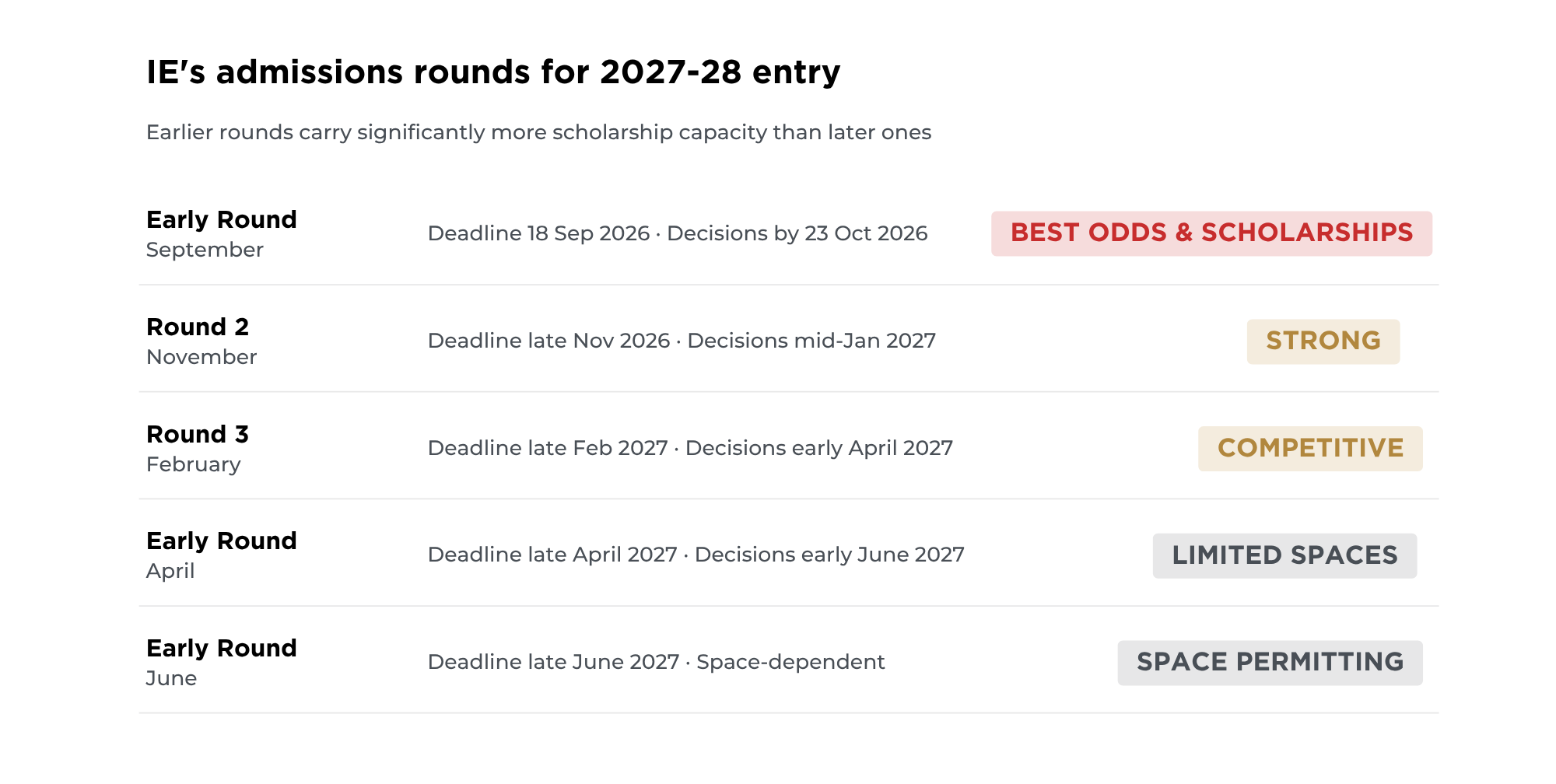
IE operates rolling admissions, but inside a structured round system. Rather than two fixed sessions, IE opens several application rounds across the admissions cycle, each with its own deadline and decision date. The earlier the round, the more places and scholarships are available.
Scholarship consideration is round-dependent
IE's scholarship capacity is heavily frontloaded to the Early and second rounds. By the time Round 3 opens, scholarship allocations have typically been reduced significantly, and by Round 4 they may be nominal. The practical implication for cost-conscious UK applicants is clear: a strong application submitted to the Early Round carries materially better odds of a scholarship offer than the same application submitted later in the cycle.
Reapplication within a cycle
Unlike many universities, IE allows unsuccessful early applicants to resubmit in a later round of the same cycle, with the opportunity to retake the admissions test or submit a stronger piece of qualitative material. This flexibility makes IE one of the lower-risk early applications in the European set.
Deadlines and the hard enrolment cutoff
IE's application deadlines move with the round structure above. What does not move is the legal enrolment deadline, which is set by Spanish Ministry of Education regulation and applies uniformly to every incoming student.
The hard enrolment deadline is 15 October 2027. All legal enrolment documents, including verified secondary school qualifications, must reach IE University Admissions by this date. Missing this deadline invalidates an otherwise successful admission.
UK qualification verification
UK applicants need their A-Level or IB results verified by the UNED Asis platform (Spain's national university qualifications body) before they can formally enrol. This process can take several weeks and is not something to leave until September. Starting the UNED Asis process as soon as your results are confirmed in August is the safe approach.
Scholarship deadline
For maximum scholarship consideration, IE encourages applicants to complete their admission and scholarship applications by 15 April of the application year. The IE Financial Aid Committee and IE Foundation reserve the right to award scholarships both before and after this date, but a majority of significant awards are determined by then.
The IE Admissions Test
The IE Admissions Test, usually referred to as the ieGAT, is IE's own bespoke entrance examination. It is not standardised against SAT-style content. The ieGAT measures verbal, logical and numerical reasoning in a format closer to a graduate school admissions test (GMAT or GRE) than to a secondary school examination.
What the ieGAT actually tests
The verbal reasoning section tests reading comprehension at a professional rather than academic level. The logical reasoning section rewards pattern recognition and formal logic under time pressure. The numerical reasoning section tests speed and accuracy with data interpretation, including charts and tables, rather than advanced mathematics. Students who have prepared for the SAT, UCAT or GMAT will find the format familiar. Students who have only prepared for A-Level examinations typically find it unlike anything they have sat before.
No published cutoff score
IE does not publish a minimum or competitive ieGAT score. The test result feeds into the Admissions Committee's holistic review alongside the other five components. What is clear from admitted-student patterns is that competitive applicants perform strongly rather than merely adequately, and that a weaker ieGAT score typically needs to be compensated for by stronger qualitative material elsewhere in the file.
The SAT, ACT and LNAT alternative
IE accepts a range of standardised tests as alternatives to the ieGAT. This flexibility is particularly useful for UK applicants who are also applying to US universities, or for Law applicants who are already preparing for the LNAT as part of their UCAS applications.
Choosing between the routes
If you are already preparing for the SAT or ACT for US applications, use that score for IE too. It saves time and consolidates your test preparation. If you are preparing for the LNAT as part of a UK Law application, IE accepts it directly for its Bachelor of Laws. For applicants targeting IE as a standalone application, the ieGAT is often the more efficient choice, particularly for programmes outside Law and Business where the SAT does not add additional signal beyond what the ieGAT already provides.
GPA and academic profile
IE does not publish a minimum GPA threshold, and the Admissions Committee explicitly reads academic records in context. That means the balance of your subjects, the demand of your curriculum and your school's grading patterns are read alongside the raw grades themselves.
UK equivalents
IE provides no formal UK grade requirement, but admitted-student patterns suggest the following profile is competitive across most programmes. Specialist technical programmes (Applied Maths, CS and AI, Data and Business Analytics) require stronger quantitative evidence than the general average.
-2.png?width=2000&height=740&name=US%20Guides%20Charts%20and%20Tables%20(3)-2.png "US Guides Charts and Tables (3)-2")
-1.png?width=2000&height=756&name=US%20Guides%20Charts%20and%20Tables%20(2)-1.png "US Guides Charts and Tables (2)-1")
Programme-specific prerequisites
Some IE programmes require specific subject preparation. The Bachelor in Computer Science and AI expects applicants to have taken AP Calculus (AB and BC), or equivalent evidence of calculus-level mathematics. The Bachelor in Applied Mathematics expects Mathematics Expert-level preparation. The Bachelor in Data and Business Analytics requires strong Mathematics evidence across both of these levels. For UK applicants, Further Mathematics at A-Level or Higher Level Mathematics at IB generally meets these prerequisites.
Programmes IE
IE offers a broader spread of English-taught Bachelor's programmes than most European competitors, extending well beyond business and economics into design, architecture, humanities and the sciences. Programme choice determines both your campus and, for some programmes, additional test requirements.
.png?width=1080&height=1350&name=Copy%20of%20TLP%20-%20CSR%20(1).png "Copy of TLP - CSR (1)")
The two-campus question
Madrid is IE's main campus and hosts most business, economics, law, and quantitative programmes. Segovia is IE's historic campus and hosts the design, architecture, communication and humanities programmes. The two campuses sit about ninety minutes apart by high-speed rail, and students can move between them for specific modules, but your primary residence and student experience are tied to the campus of your programme. Visiting both before committing is strongly recommended.
Dual degrees
IE offers a growing number of dual-degree programmes that combine two Bachelor's across four or five years, typically pairing Business, Law or International Relations with a second subject. These programmes have their own application requirements and should be approached as distinct applications rather than add-ons to a standard Bachelor's.
Essays, interview and recommendations
IE's holistic review means that three qualitative components (the personal statement, two letters of recommendation, and the interview) carry real weight. These are what most clearly distinguish IE from Bocconi and other formula-driven European universities, and they are also where UK applicants most often undersell themselves.
The personal statement
IE's application asks for a personal essay introducing you to the Admissions Committee. The strongest essays we see at IE are specific to the programme being applied to, honest about the applicant's trajectory, and anchored in a particular moment or decision rather than a sweeping summary of achievements. IE values international perspective and leadership orientation, so threads that connect your experience to those themes read particularly well.
This is a different writing task from both the UCAS personal statement and the Common App essay. The UCAS statement defends an academic case for a single subject. The Common App essay reveals personal character. The IE personal statement sits somewhere between, blending motivation for the programme with evidence of the person you have become.
Letters of recommendation
IE asks for two letters of recommendation, typically from teachers or counsellors who have worked with you recently and can speak to both your academic ability and your character. Choose referees who know you well rather than those with the most impressive titles. A warm, specific letter from a teacher who has watched you develop over two years is worth more than a formal letter from a headteacher who barely knows you. Brief your referees properly: give them your personal statement, your target programme, and any specific points you would like them to address.
The admissions interview
The interview is conducted by a trained IE Admissions adviser, usually by video call, and lasts around 30 to 45 minutes. It is conversational rather than technical. The adviser will have read your file beforehand and will ask about your motivation, your international perspective, your extracurricular work and your fit with IE's community. Preparation matters. Researching IE's specific programme content, having clear answers for why this programme and why IE, and being ready to speak confidently about your essays all signal the kind of engagement IE is looking for.
The online video assessment
IE also asks for a short online video assessment, in which you respond to a small number of prompts on camera within a fixed time. It is designed to see how you communicate in English and under light pressure. Preparation involves getting comfortable on camera, practising concise answers, and ensuring your technical setup (lighting, audio, background) is professional.
Building the application over four years
Because IE's Early Round deadline falls in September of Year 13, the practical timeline for a UK applicant is compressed compared with UCAS and significantly compressed compared with US universities. Here is what to be working on at each stage.
.png?width=2000&height=1414&name=US%20Guides%20Charts%20and%20Tables%20(5).png "US Guides Charts and Tables (5)")
Arriving later in the timeline is more manageable at IE than at most selective universities, thanks to its rolling round structure. A UK student who comes to IE as a late addition to their shortlist can still submit a competitive application in Round 2 or Round 3, provided they allow enough time for ieGAT preparation and a properly drafted personal statement.
Why choose A-List?
Our IE admissions consultants help students to strategically showcase their strengths, giving them a decisive edge in competitive admissions. See some of our exceptional results:
Getting into IE: FAQs
No. IE accepts the SAT (minimum 1200), ACT (minimum 24) and LNAT (minimum 22, for Law applicants) in place of the ieGAT. If you are already preparing for the SAT for US applications, use that score for IE too. If IE is your primary test-based application, the ieGAT is often the more efficient choice, since it is sat under IE's own structure and does not involve the travel and scheduling complexity of SAT sittings.
Your campus is tied to your programme. Business, Economics, Law, International Relations, PPLE and the technical programmes (CS and AI, Data and Business Analytics, Applied Mathematics) are based in Madrid. Design, Architecture, Fashion Design, Humanities and Communication are based in Segovia. The two campuses sit about ninety minutes apart by high-speed rail, and some teaching crosses both, but your primary residence and student experience are tied to your programme's main campus.
The Early Round, if your file is ready. Earlier rounds carry significantly more scholarship capacity, and IE's rolling structure means later rounds work from a reduced place pool. The exception is when a strong qualitative component (personal statement, interview preparation) will materially benefit from an extra two months of work. Submitting a stronger application in Round 2 or Round 3 can outperform a rushed Early Round submission.