
How to get into Columbia
How hard is it to get into Columbia?


Columbia is one of the most selective universities in the Ivy League, and its admissions process carries two structural features that set it apart from its peers: a binding Early Decision round, and a shared academic foundation called the Core Curriculum that shapes who applies in the first place.
Columbia sits in Morningside Heights, a residential neighbourhood at the top of Manhattan. Its urban location is genuinely formative: students live, study and intern inside New York City rather than beside it. For UK applicants weighing Columbia against other Ivies, the New York factor matters in ways that only become visible once you spend time on campus. It shapes the kind of student Columbia attracts and the kind of application that lands well.
Columbia's applicant pool is one of the largest of any Ivy, and its yield is relatively lower than peers like Harvard and Yale, meaning Columbia extends more offers to fill a comparable class. For the Class of 2029, Columbia received close to sixty thousand applications and admitted around three thousand students. Fewer than one in twenty applicants received an offer.
The good news is that Columbia's evaluation criteria are among the most explicit in the Ivy League. Its Common Data Set rates seven separate factors as "Very Important," including essays, character, rigour of curriculum, and extracurricular engagement. The rest of this guide walks through what each of those elements actually looks like in a competitive application, and how UK students can shape the pieces they control.
Columbia College versus Columbia Engineering
Columbia's undergraduate admissions happens across two separate schools, and applicants choose one at the application stage. This is a Columbia-specific design decision that has real strategic implications. You cannot apply to both, and switching between them after enrolment is possible but not guaranteed.
The liberal arts school
Columbia's founding undergraduate school. Houses humanities, social sciences and most of the natural sciences. Students take the full Core Curriculum alongside their chosen concentration. The larger of the two schools by enrolment.
The engineering school
The Fu Foundation School of Engineering and Applied Science. Covers engineering, computer science and applied mathematics. Students take a lighter Core requirement plus technical foundation courses. Smaller cohort than Columbia College.
Which school should you apply to
The honest answer is that your choice should follow your genuine academic interests rather than an attempt to arbitrage acceptance rates. The two schools select for different profiles: Columbia College admits students across the humanities, social sciences and natural sciences, with the Core Curriculum as the unifying experience. Columbia Engineering selects for technical capability, maths and science rigour, and clear evidence of engineering or quantitative thinking.
A student who is primarily interested in economics, politics, history, English, biology, physics or pre-medical study should apply to Columbia College. A student who is primarily interested in engineering, computer science, data science or applied mathematics should apply to Columbia Engineering. Applying to the wrong school rarely produces a better outcome, because the admissions officers reading each pool are looking for specific kinds of evidence.
The Core Curriculum factor
Columbia College's Core Curriculum is the most famous shared academic sequence in American higher education. Every College student takes Literature Humanities, Contemporary Civilization, University Writing, Art Humanities, Music Humanities, Frontiers of Science, a foreign language and physical education. The reading list is largely fixed and runs from Homer and Plato through the Bible, Dante, Shakespeare, Marx, Austen, Du Bois and Beyonce. Engineering students take a lighter version of the Core.
Prospective applicants to Columbia College should read a little about the Core before applying. If the idea of spending your first two years reading those texts alongside classmates genuinely appeals, Columbia College is a strong fit. If it feels like an obligation to get through, another university's open curriculum (Brown, for example) is probably a better match.
The academic profile of admitted students
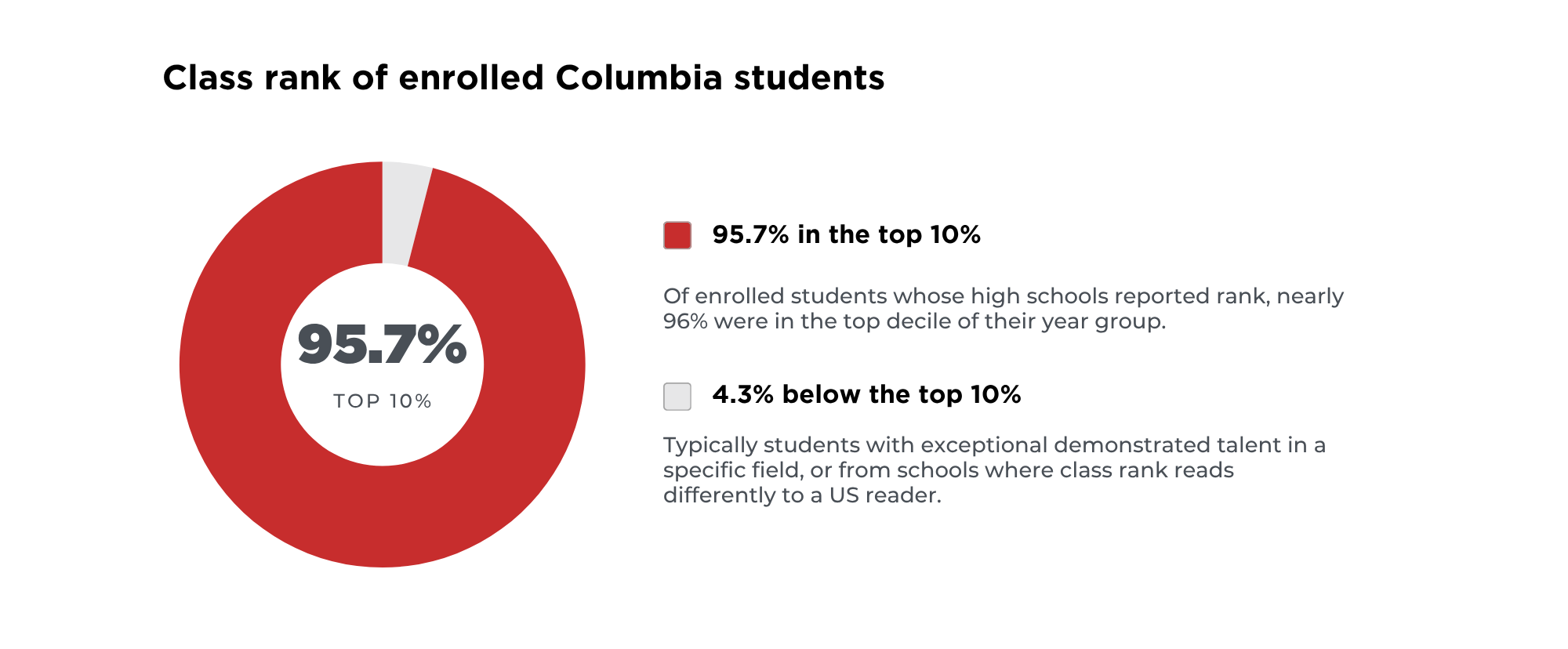
Columbia reads applications contextually rather than against published cutoffs. What its Common Data Set reveals is the profile of students the university actually enrols. That profile sits, as at every top Ivy, at the very top of the academic distribution.
UK equivalents
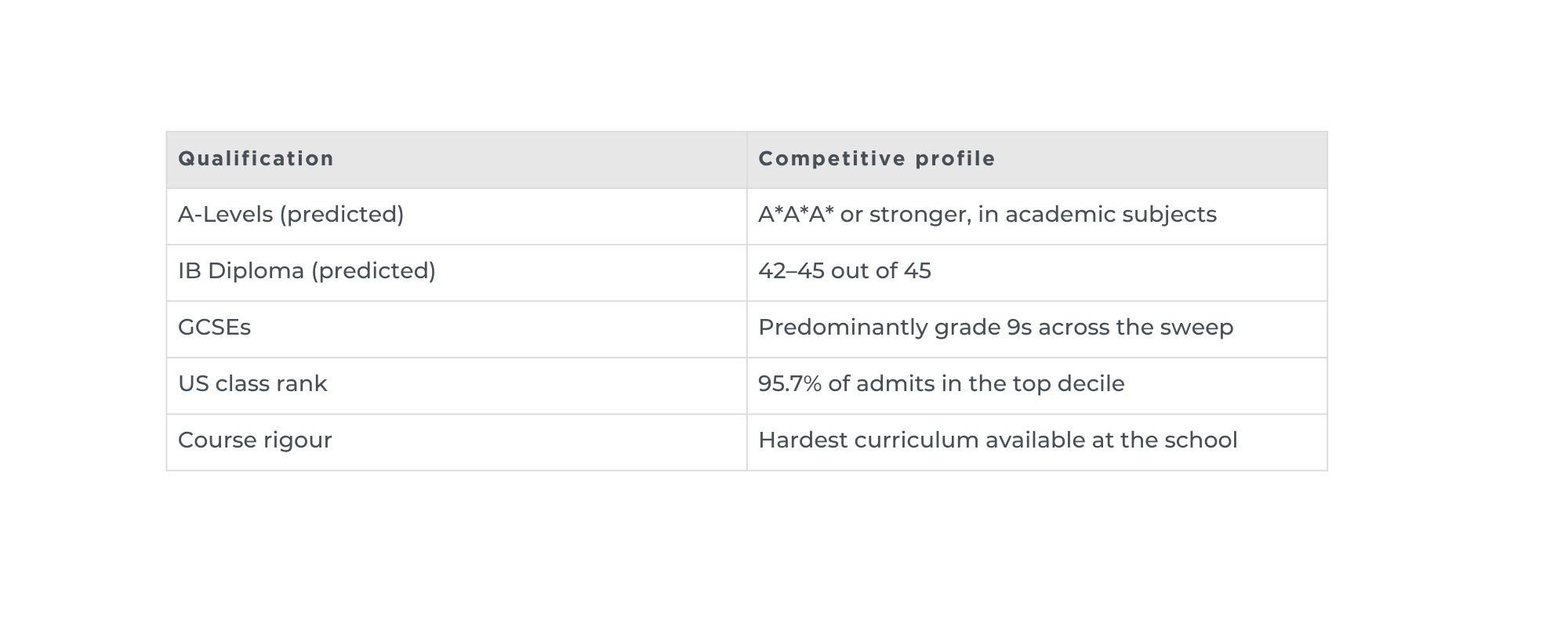
Columbia publishes no formal grade requirement for UK qualifications, and reads them contextually. In practice, competitive UK applicants typically hold predicted grades of A*A*A* or stronger in academic subjects aligned with their intended concentration. For IB applicants, predicted scores of 42 to 45 are the range Columbia reads as competitive. GCSEs form part of the picture, and a strong sweep of grade 9s adds genuine weight to the file.
Columbia rates more factors as "Very Important" than most Ivies
Columbia's Common Data Set labels seven separate factors as Very Important: rigour of secondary school record, class rank, academic GPA, application essay, recommendations, character and personal qualities, and extracurricular activities. This is more than Harvard, Princeton or Yale explicitly flag at the highest weighting. The practical implication is that an application built around genuine strength across all seven is read very differently from one that leans on grades and test scores alone.
What UK and international applicants need to know
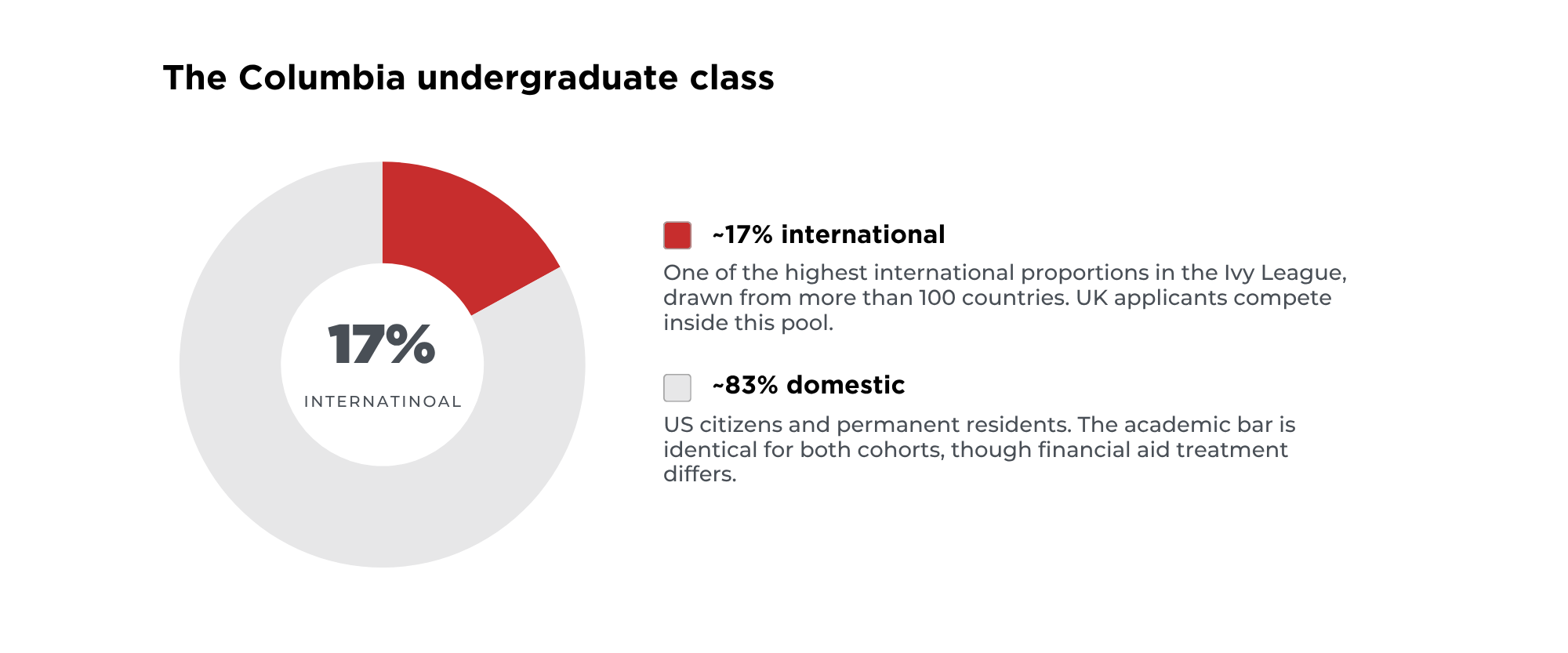
International students make up roughly 17 per cent of Columbia's undergraduate class, one of the highest proportions in the Ivy League. New York's international orientation is reflected in the student body, and Columbia actively recruits from around 100 countries each year. UK applicants are a familiar part of that pool.
Columbia is need-aware for international applicants
This is the single most important point for UK families to grasp, and it mirrors Stanford's approach rather than MIT's. Columbia is need-blind for US citizens and permanent residents, but it considers financial need as a factor in admission decisions for international applicants. The upside is that Columbia meets 100 per cent of demonstrated need for every admitted student, including internationals, without loans. The downside is that a request for substantial aid can affect the admission decision itself.
No alumni interview
Unlike most of its Ivy peers, Columbia does not offer or require an alumni interview as part of the admissions process. This simplifies the application calendar for UK applicants, but it also removes one route for a strong personal impression to influence the file. The written material carries more of the weight that an interview might otherwise share.
Predicted grades and the counsellor letter
You will apply during Year 13, before your A-Level or IB results are final. Columbia reads predicted grades in the context of your school's track record and your GCSE results. A one-paragraph note in the counsellor's letter explaining the UK grading system and your sixth form's curve gives your file the context it needs.
Testing access from the UK
SAT and ACT sittings run several times a year at UK test centres, mostly in London and larger cities. For 2027 entry Columbia remains test-optional, so UK students with weaker test access have a completely legitimate path. For applicants targeting Fall 2028 entry and beyond, testing is required and sittings should be booked well in advance.
Before booking, take a free mock SAT test to see where your score sits.
Application deadlines and key dates for Stanford
Below are the standard dates for the 2026–27 application cycle (for 2027 US university entry). Always confirm the current-year specifics on Columbia's own admissions site before submitting.
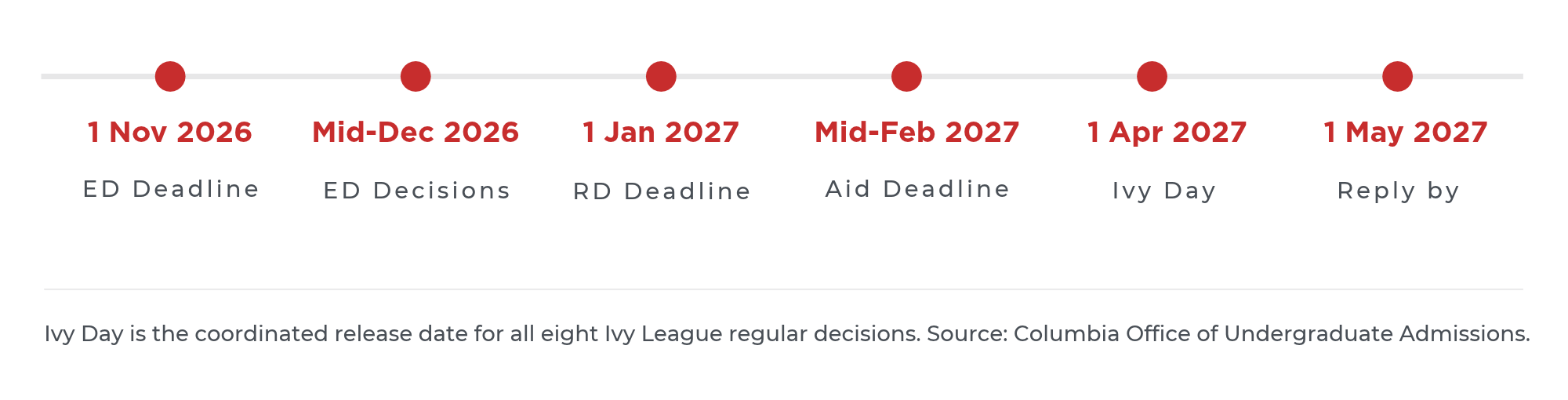
For UK students, the January Regular Decision deadline sits conveniently alongside the 15 January UCAS equal consideration deadline. Running both applications in parallel is straightforward in principle, though the writing demands are genuinely different. Columbia's binding ED deadline of 1 November is a harder decision point: committing to Columbia binding means forgoing early applications anywhere else and withdrawing all other applications if admitted.
SAT & ACT testing at Columbia
Columbia's testing policy is in transition. For 2027 entry (the 2026–27 admissions cycle), Columbia remains test-optional. You can submit an SAT or ACT score if you want to, and the admissions office will consider it, but no test is required. Columbia announced in June 2026 that testing will return for the 2027–28 cycle, meaning applicants targeting Fall 2028 entry and beyond will need to submit scores.
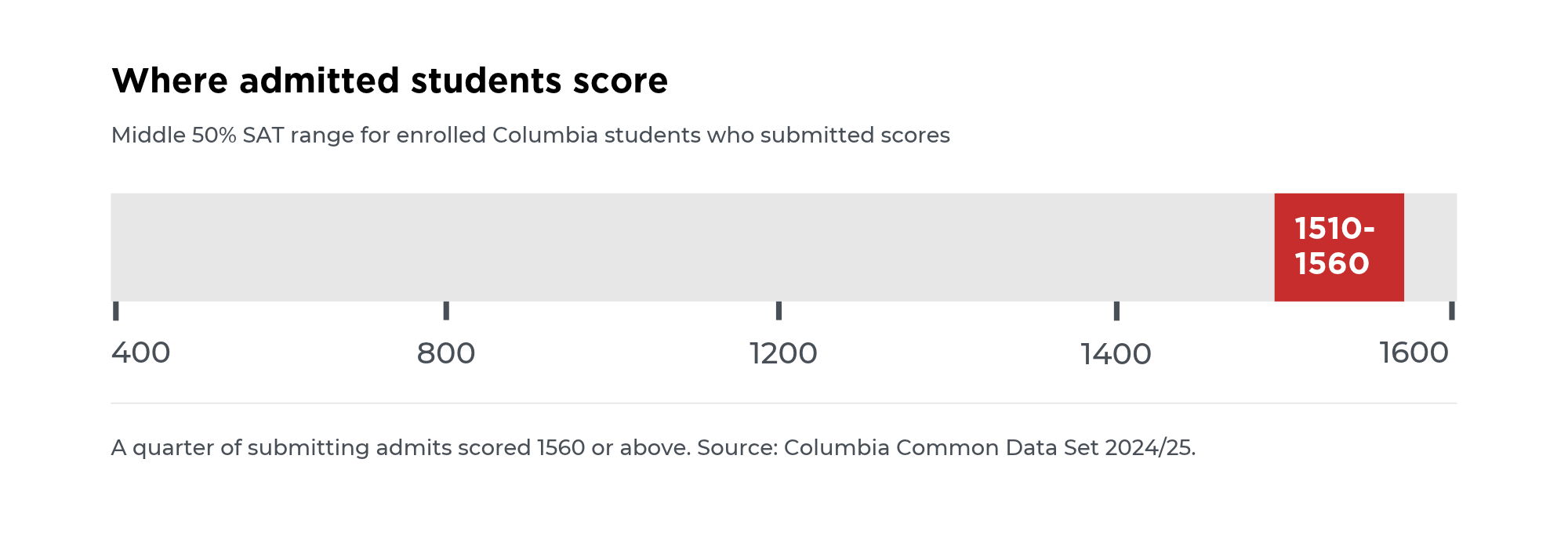
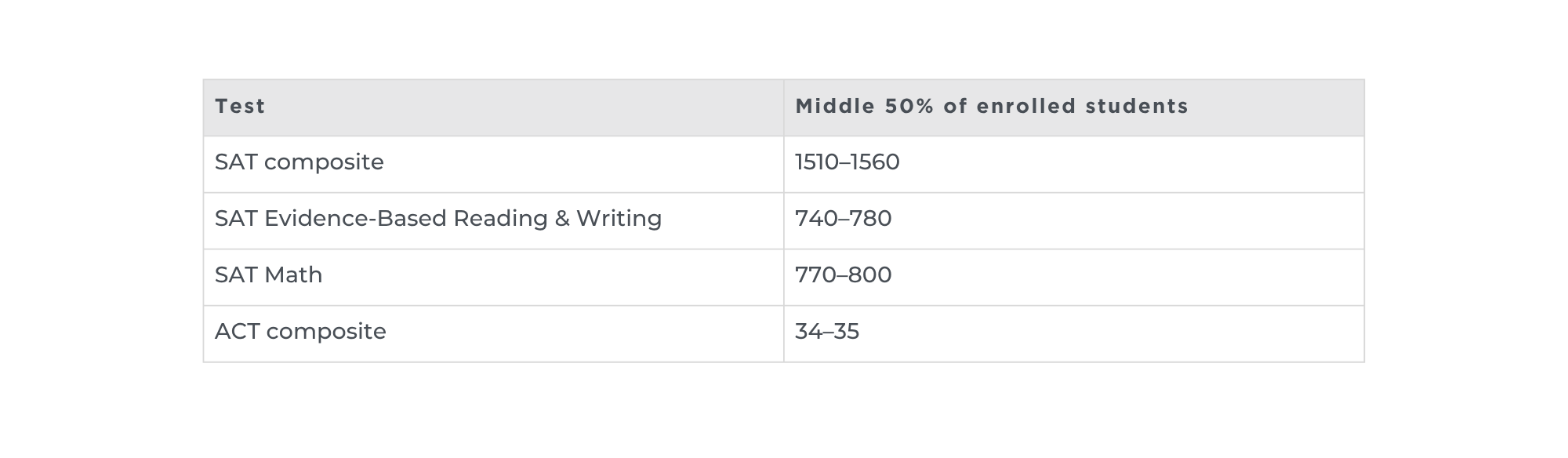
The score profile of enrolled students shows what a competitive submitted score looks like.
Should you submit a test if you have one
If your score sits inside the middle 50 per cent band, submitting reinforces the academic case. If your score is meaningfully below that band and your file is genuinely strong elsewhere, going test-optional is a legitimate strategic choice while Columbia still offers it. What you should not do is hold off on testing preparation on the assumption that test-optional will continue: the requirement returns for Fall 2028 entry regardless.
SAT or ACT
Columbia treats both tests as equivalent and superscores both. The choice comes down to which suits you as a test-taker. UK students can sit both at test centres in London and other major cities. A short diagnostic in each is the fastest way to see which plays to your strengths. Plan for two or three sittings before the deadline.
Early Decision versus Regular Action
Columbia offers two application routes: binding Early Decision (ED) and Regular Decision (RD). The ED structure is a major point of difference from Harvard, Yale, Princeton and Stanford, and it needs to be understood properly before committing.
What "binding" actually means
If Columbia admits you through Early Decision, you are contractually obliged to attend. You must withdraw every other active US application, you cannot apply to any other US private university's early round once you have submitted the Columbia ED application, and you lose access to the standard May reply date for comparing other offers. The commitment is genuine and enforceable: admitted ED students who fail to enrol can face consequences with other universities that share admissions data.
One exception matters for UK families. If Columbia's financial aid offer is insufficient to make attendance possible, an admitted ED student can be released from the binding commitment. The onus is on the family to make the case in good faith, and it is not a loophole to be exercised casually.
The acceptance rate gap
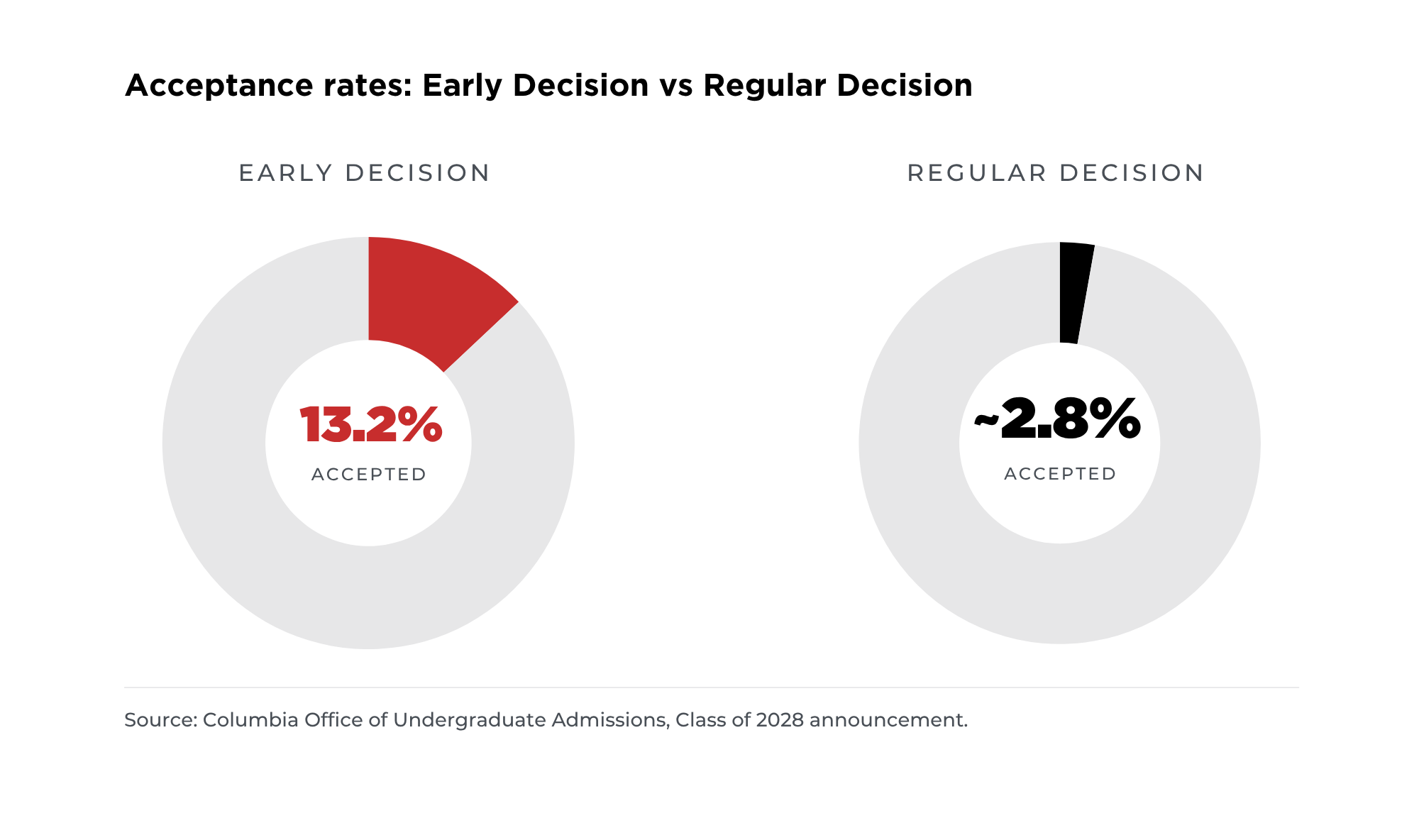
Columbia's ED acceptance rate is roughly five times its Regular Decision rate. This is a larger gap than the REA/RD gap at Harvard or Stanford, and it reflects something real about binding Early Decision: Columbia uses ED to lock in students who have declared Columbia as their first choice, and the strategic incentive to admit a qualified ED applicant is stronger than for a non-binding early round. Approximately half of each Columbia class is now filled through Early Decision.
Should you apply ED
The question is not whether ED gives you better odds, which it demonstrably does. The question is whether you are genuinely certain Columbia is your top choice, and whether the financial aid you will be offered is likely to be workable. Two tests matter. First: if you were admitted to Columbia and to any other university you are also considering, would you pick Columbia without hesitation? Second: is your family's financial picture one where Columbia's aid package will almost certainly be workable? If both answers are yes, ED is a strong strategic choice. If either answer is uncertain, Regular Decision is the safer route.
Common App and Stanford distinctive essays
Columbia's essay supplement is one of the most distinctive in the Ivy League, and it rewards a different kind of writing from Harvard, Yale or Stanford. Where other supplements ask for extended reflection, Columbia asks for compression. Five short-answer essays at 150 words each, plus a 100-word list that is not an essay at all. There is no interview, so the essays carry more weight than at peer universities.
The Common App essay
You will write one Common App personal statement, up to 650 words, that goes to every US university you apply to. It is not a CV in prose form. The strongest essays are specific, honest and quietly confident, revealing character through a particular moment rather than summarising achievements the reader can see elsewhere in the file.
The Columbia supplement
Columbia's supplement is six required components. Every applicant writes all six. There is no choice between prompts.
The list is not an essay
Columbia's opening supplement is genuinely unusual. You are asked for a list of texts, resources and outlets that have shaped your intellectual development outside your academic courses, in 100 words or fewer. You separate the items with commas or semicolons. You do not add author names, subtitles, italics, or explanatory remarks. It is a list.
The list reveals a great deal in a small space. It shows what pulls your attention outside the curriculum, what communities and ideas you have sought out, and what sits in your mind when a stranger asks what you have been reading. Spend genuine time on it. The strongest lists are specific, honest and show range rather than parading erudition.
Compression as the skill
The five 150-word essays reward compression above almost any other skill. The standard three-paragraph essay structure does not fit. What works is one specific moment, told cleanly, with a reflection that earns its place rather than filling space. Admissions officers reading Columbia files have seen every variation of the generic Why Columbia essay. The ones that cut through name specific Columbia resources, specific professors, specific courses, specific features of New York, and connect them to specific parts of the applicant's trajectory.
Common App essay versus UCAS personal statement
UK students sometimes hope to repurpose their UCAS personal statement for the Common App. It rarely works. UCAS defends an academic case for a single subject. The Common App essay introduces you as a whole person. Columbia's supplement then builds on that introduction with five tightly focused angles. Treat all three as separate writing tasks.
Extracurriculars and the Core mindset
Columbia reads extracurriculars through the Core Curriculum's lens: not just what you have done, but what it reveals about how you engage with ideas and with other people. Columbia's Common Data Set rates extracurricular activities as Very Important, which puts it alongside only a handful of other top Ivies in giving them that explicit weight.
The pattern Columbia rewards is depth and demonstrable output, not breadth. The Common App activities list offers ten slots, and the strongest Columbia applications use only the slots that carry real weight. A student with one or two areas of sustained commitment that have produced tangible achievement, work or contribution, reads more compellingly than one with ten superficial involvements.
The New York factor
Columbia's location opens extracurricular opportunities that other Ivies simply cannot match. Students intern at Goldman Sachs, Vogue, the Metropolitan Museum, the United Nations and the New York Times during term, not just over the summer. Applicants who can demonstrate meaningful engagement with urban-culture institutions, with activism, with journalism or with the arts in a city setting are reading right into the Columbia experience.
For UK students specifically
British sixth forms produce students with generalist extracurricular profiles: house prefect, DofE, a couple of sports, a society role. That reads as normal to Columbia rather than strong. The students we help place at Columbia almost always have one or two areas where their commitment goes well beyond the school menu, with outputs someone outside their family would recognise. Debate, journalism, Model UN, published research, creative writing competitions, and self-initiated projects all map well onto Columbia's Core-shaped culture.
When should you start preparing for Columbia?
Columbia rewards depth built over time, and specifically the kind of engaged intellectual curiosity that the Core Curriculum assumes in incoming students. The sooner the reading, writing and self-initiated work starts, the stronger the file eventually looks. Here is what strong applicants are doing at each stage.
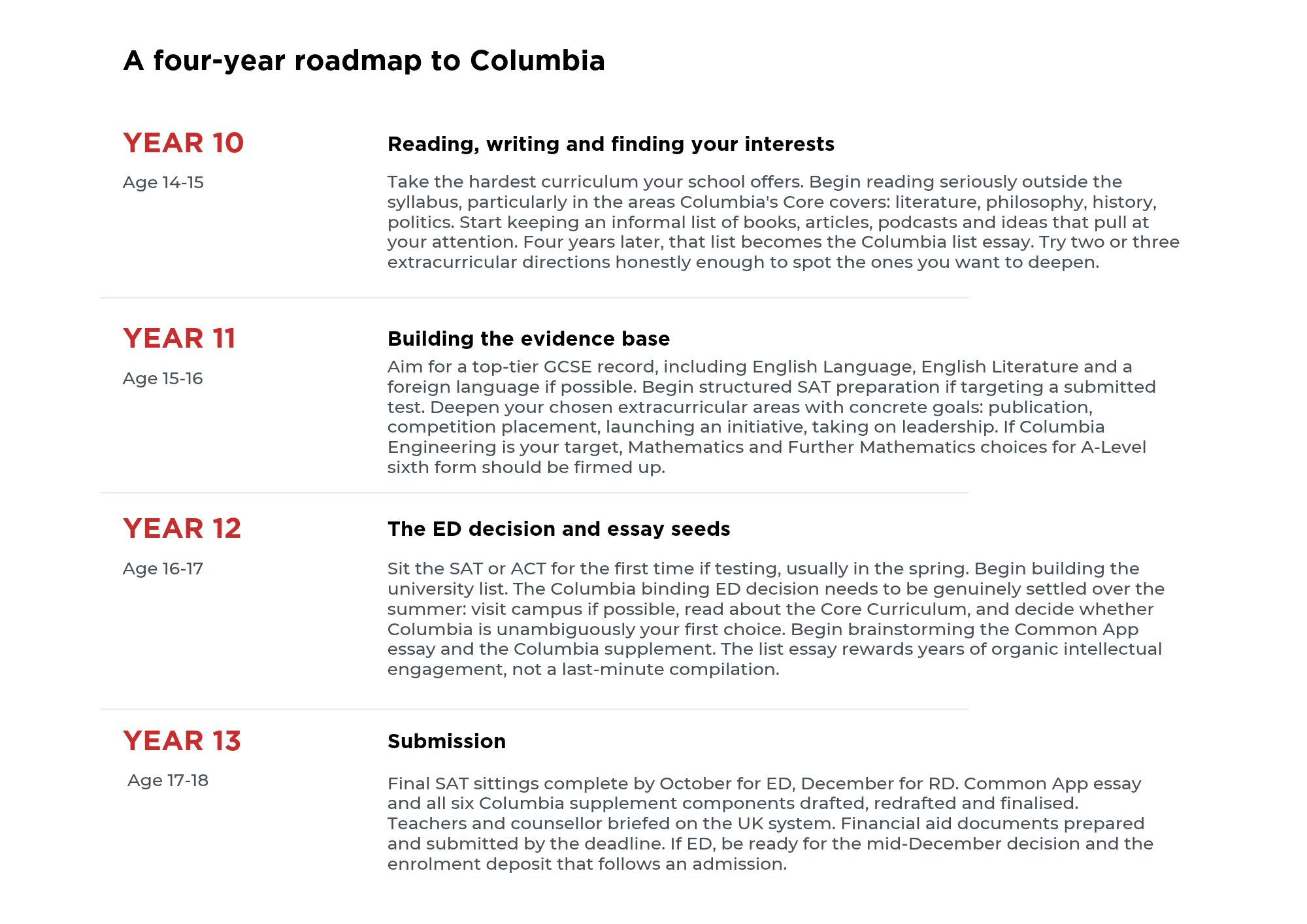
Arriving later in the timeline is possible, and we work successfully with students who come to us in Year 12 or even Year 13. The reading that Columbia assumes is harder to synthesise retroactively than the test preparation or the essay drafting. For late-starters, the realistic strategy becomes surfacing the intellectual engagement that is already there, telling it at its strongest, and adding the one or two concrete outputs that remain possible in the time available.
Why choose A-List?
Our private consultancy empowers students to strategically showcase their strengths, giving them a decisive edge in competitive admissions. See some of our exceptional results:
Getting into Stanford: FAQs
Columbia's ED is binding: if admitted, you are contractually obliged to attend and must withdraw every other active US application. Restrictive Early Action at Harvard, Yale and Stanford is non-binding: you can wait until May to reply and compare other offers. This is the single most important strategic difference. ED is only the right choice if Columbia is unambiguously your first choice and your family's financial picture is likely to produce a workable aid package.
Follow your genuine academic interests, not an attempt to arbitrage acceptance rates. Columbia College admits students across the humanities, social sciences and natural sciences, with the Core Curriculum as the unifying experience. Columbia Engineering (SEAS) selects for technical capability, maths rigour and clear engineering or computer science interest. Applying to the wrong school rarely produces a better outcome because the admissions readers in each pool are looking for specific kinds of evidence.
The list is a list, not a disguised essay. In 100 words or fewer, you name the titles of texts, resources and outlets that have shaped your intellectual development outside your academic courses. You separate the items with commas or semicolons. You do not include author names, italics, subtitles or commentary. The strongest lists are specific, honest, show range across different kinds of sources, and reflect genuine engagement built over years rather than a last-minute compilation.