
How to get into Stanford
How hard is it to get into Stanford?


Stanford is one of the most selective universities in the world, and it is widely considered the most selective in the United States outside the Ivy League. Understanding why starts with what Stanford is not.
Stanford sits in Palo Alto, California, next to Silicon Valley and the venture capital infrastructure that has shaped so much of the modern technology economy. It is not an Ivy. It was founded a generation later than its East Coast peers, it recruits and admits differently, and its institutional culture lives somewhere between a research university and a startup accelerator. For UK applicants, the practical meaning of that distinction matters: Stanford reads applications through the lens of who might build something new, not just who might master an existing body of knowledge.
Around sixty thousand students apply to Stanford each year, and fewer than four in every hundred are admitted. Stanford receives the largest applicant pool of any top private US university outside the UC system, and admits one of the smallest classes. The combination makes it, in raw terms, harder to get into than any Ivy.
The good news for UK applicants is that Stanford's evaluation framework is public and consistent. The essays are distinctive but knowable. The academic bar is high but definable. What separates admitted applicants from the thousands of equally capable candidates who are turned down is rarely the grades themselves. It is the combination of intellectual curiosity, demonstrated depth outside the classroom, and a voice that comes through in the written material. The rest of this guide walks through how each of those pieces fits together.
Stanford's acceptance rates and recent trends
Stanford's acceptance rate has sat in a narrow band of 3.6 to 4.3 per cent across the past five cycles. Unlike some Ivies, Stanford does not release early-round data publicly, and its Common Data Set is the only reliable source for the final figures. The university's reporting is also notably sparser than its peers: Stanford publishes less granular admissions data year-on-year than Harvard, Yale or MIT do.
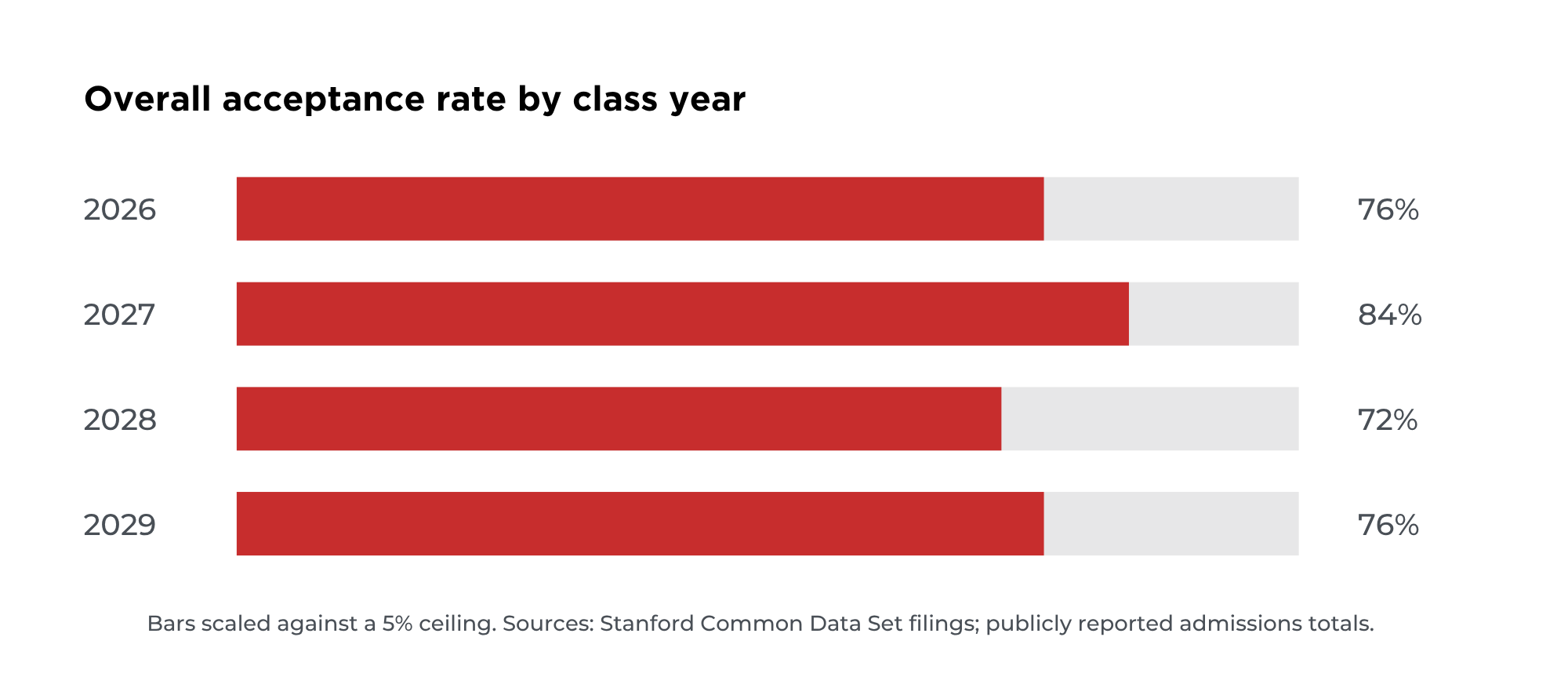
Two features of Stanford's selectivity are worth understanding. First, Stanford's class size is one of the smallest in the top tier: around 1,750 students enrol each year, compared with 1,650 at Yale, 1,650 at Princeton (post-expansion) and over 1,900 at Harvard. A fixed small class against a rising applicant pool is the mathematical reason Stanford's rate holds so stubbornly low.
Second, Stanford's yield rate is one of the highest in global higher education, consistently above 80 per cent. Four in every five admitted students choose Stanford over every other offer they hold, including Harvard. This means Stanford's waitlist is effectively inactive: in typical years, fewer than ten students are eventually admitted from the waitlist. Plan as though a waitlist decision is a rejection.
The academic profile of admitted students
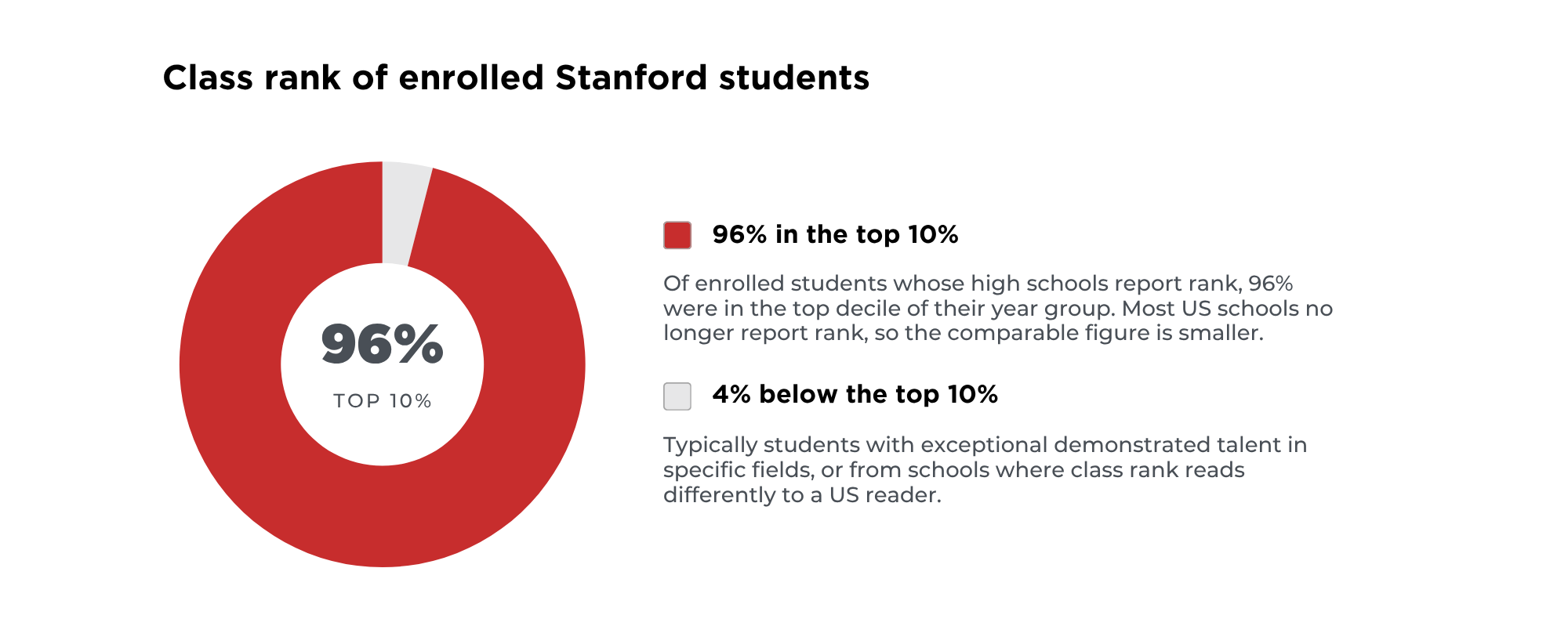
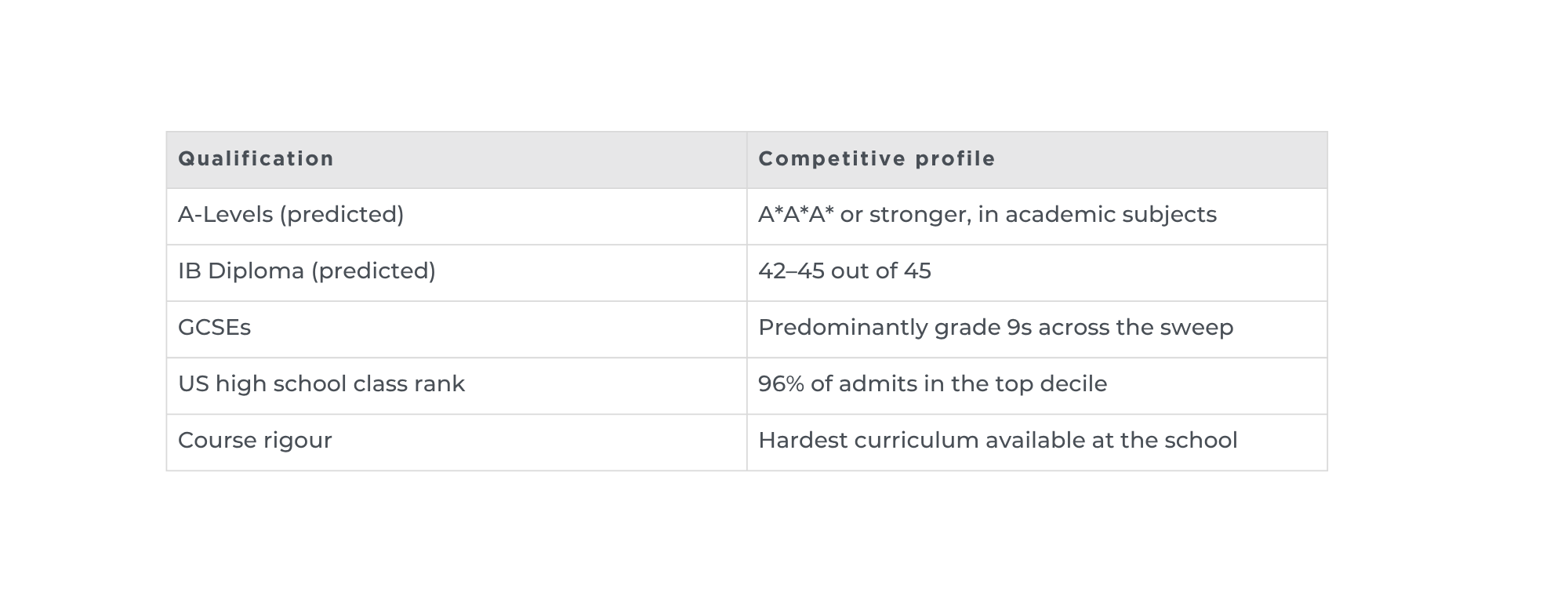
Stanford reads applications in context, and does not publish minimum grade thresholds or cutoff scores. What its Common Data Set shows is the profile of the students it enrols, and that profile is unambiguous: Stanford admits students who sit at the top of every academic measure available, with few exceptions.
UK equivalents
Stanford publishes no grade requirements for UK qualifications, and reads them contextually. In practice, competitive UK applicants overwhelmingly hold predicted grades of A*A*A* or stronger. For IB applicants, predicted scores of 42 to 45 are the range Stanford reads as competitive. GCSEs form part of the picture: a clean sweep of grade 9s adds genuine weight before predicted A-Level grades are even considered.
Course rigour matters at Stanford specifically
Stanford's Common Data Set rates rigour of secondary school record as very important. In a pool where almost every file carries top grades, rigour is one of the clearest differentiators. Stanford reads the hardest options at your school and asks whether you took them. Further Mathematics, Latin, independent extended projects such as the EPQ, Advanced Placement subjects where your school offers them: if these were available and you declined them, the admissions officer notices. The inverse is also true. A student who sought out the hardest possible combination of subjects signals exactly the intellectual appetite Stanford says it is looking for.
What UK and international applicants need to know
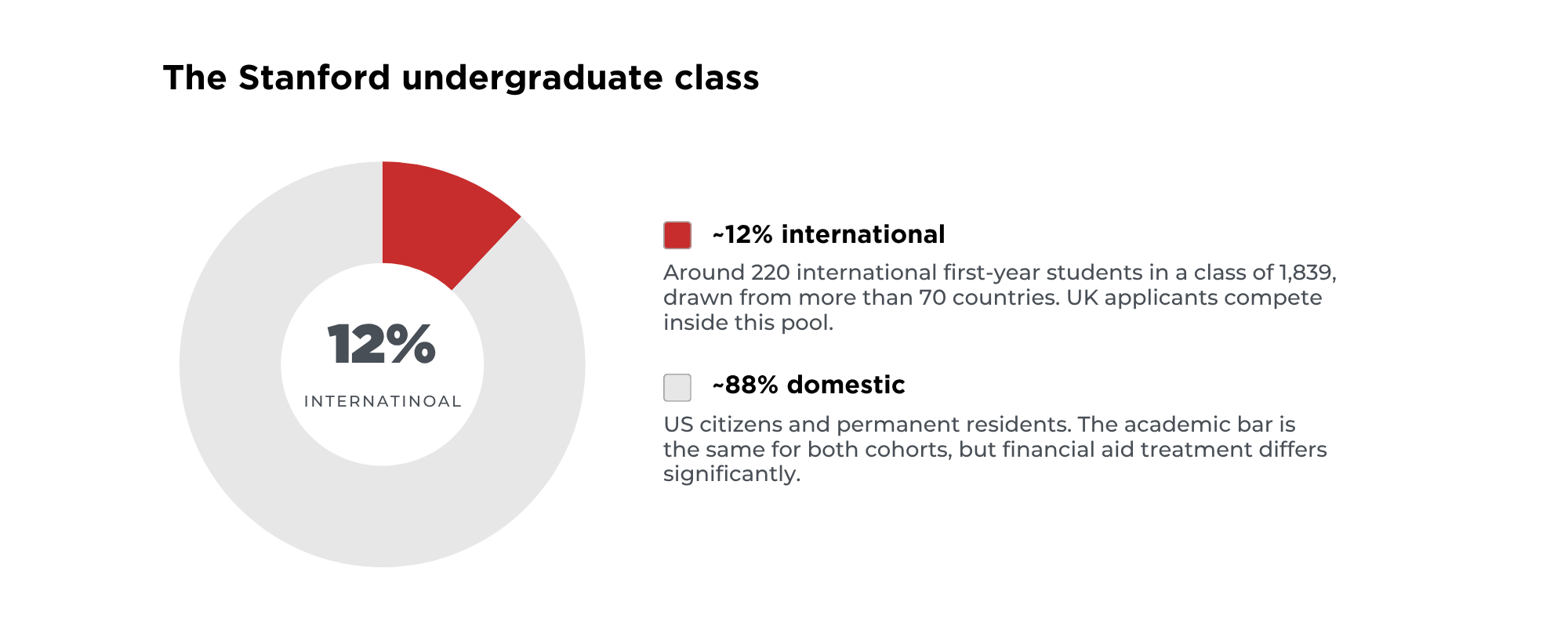
International students make up roughly 12 per cent of Stanford's undergraduate class, drawn from more than 70 countries. The academic bar for international applicants is identical to the domestic bar, though several practical and financial details sit differently for UK students.
Stanford is not need-blind for internationals
This is the single most important point for UK families to understand, and it differs sharply from MIT and from most of the Ivies. Stanford is need-blind for US citizens and permanent residents, but it does consider financial need as a factor in admission decisions for international applicants. This does not mean an international family's finances will sink an application, but it does mean that the depth and timing of a financial aid request can affect the file. Separately, Stanford does meet full demonstrated need for international students who are admitted, so the question is really about admission rather than funding.
Predicted grades and academic context
You apply during Year 13, before your final A-Level or IB results are in. Stanford reads predicted grades in the context of your school and, importantly, your GCSE record. A strong sweep across GCSE academic subjects, combined with predicted grades of A*A*A* or equivalent, is the picture Stanford's admissions officers recognise.
The counsellor brief matters more than at UK universities
Stanford's admissions office reads the school's school profile and your counsellor's letter closely. A one-paragraph note in the counsellor's letter explaining what A*A*A* means at your particular school, or how your sixth form sets its grading curve, gives your file the frame it needs. Do not assume this is understood by default.
For the Oxford or Cambridge side of a dual application, our sister company Oxbridge Applications specialises in UCAS and Oxbridge admissions.
Testing access from the UK
SAT and ACT sittings run multiple times a year at UK test centres, concentrated in London and larger cities. Register early, because places near the November REA deadline fill up months in advance. Plan for two or three sittings before the final deadline, since Stanford superscores both the SAT and the ACT.
Before booking, take a free mock SAT test to see where your score sits.
Application deadlines and key dates for Stanford
Below are the standard dates for the 2026–27 application cycle (for 2027 US university entry). Always confirm the current-year specifics on Stanford's own admissions site before submitting.
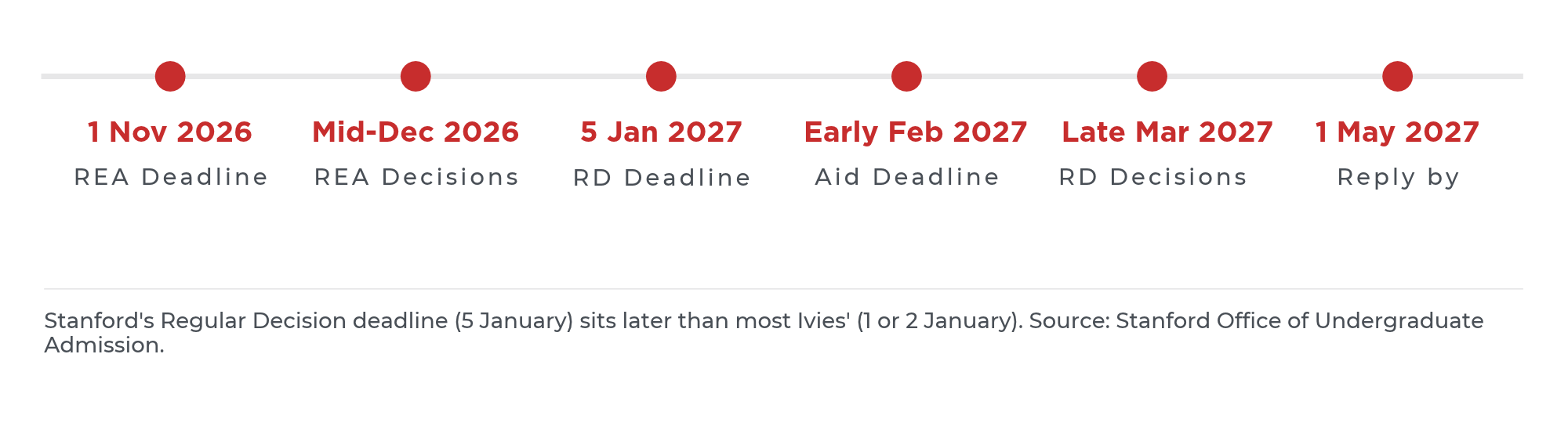
For UK students, the January Regular Decision deadline sits conveniently after the 15 January UCAS equal consideration deadline. Running both applications in parallel is manageable, and many of our students do exactly that. The Common App essay and the UCAS personal statement reward very different approaches, which we cover in detail further on.
The 1 November REA deadline is the earlier of the two, and it is also when the strongest UK applications tend to land. If your file is genuinely ready by late October, the REA round offers real statistical advantage. If it is not ready, the January deadline gives you two more months to strengthen the essays, retest, or add a meaningful piece of work.
SAT & ACT at Stanford
Stanford reinstated its standardised testing requirement with the Class of 2030 (Fall 2026 entry). For applicants targeting 2027 entry and beyond, a standardised test score is required. There is no test-optional or test-flexible pathway: you must submit either an SAT or ACT score.
The score profile of enrolled students reflects Stanford's academic bar in practice.
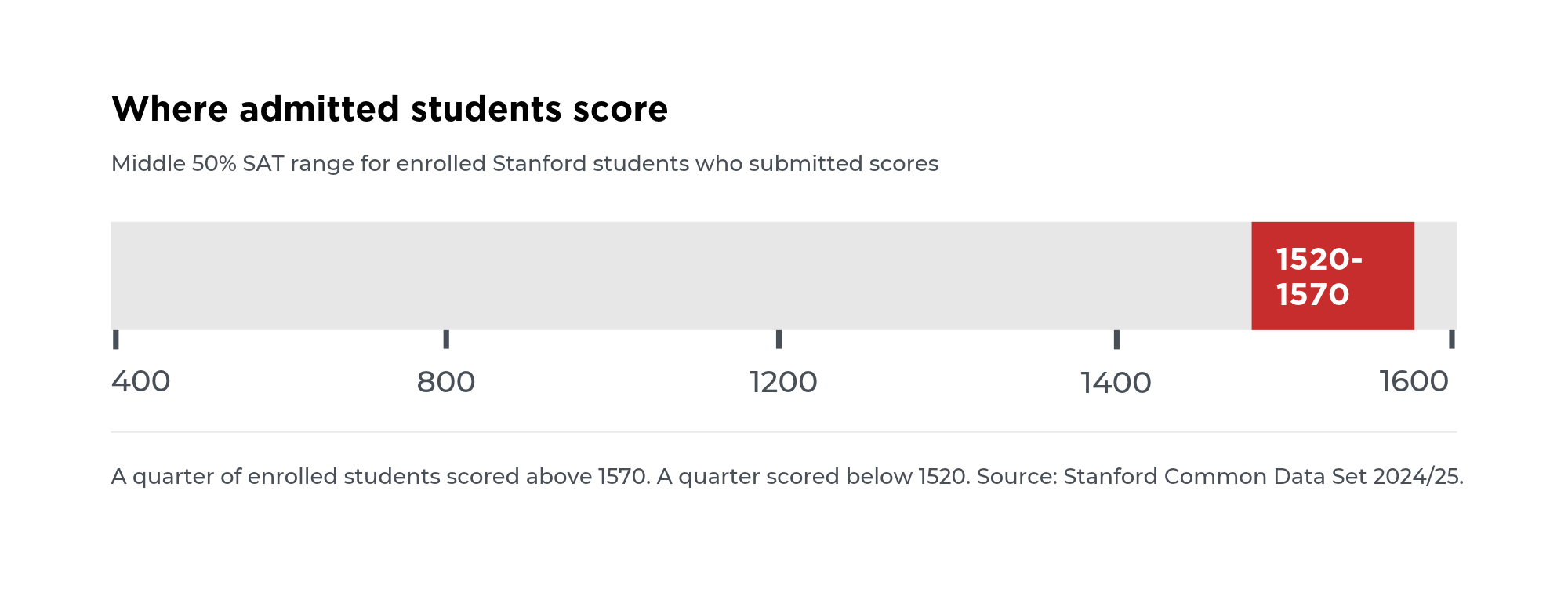
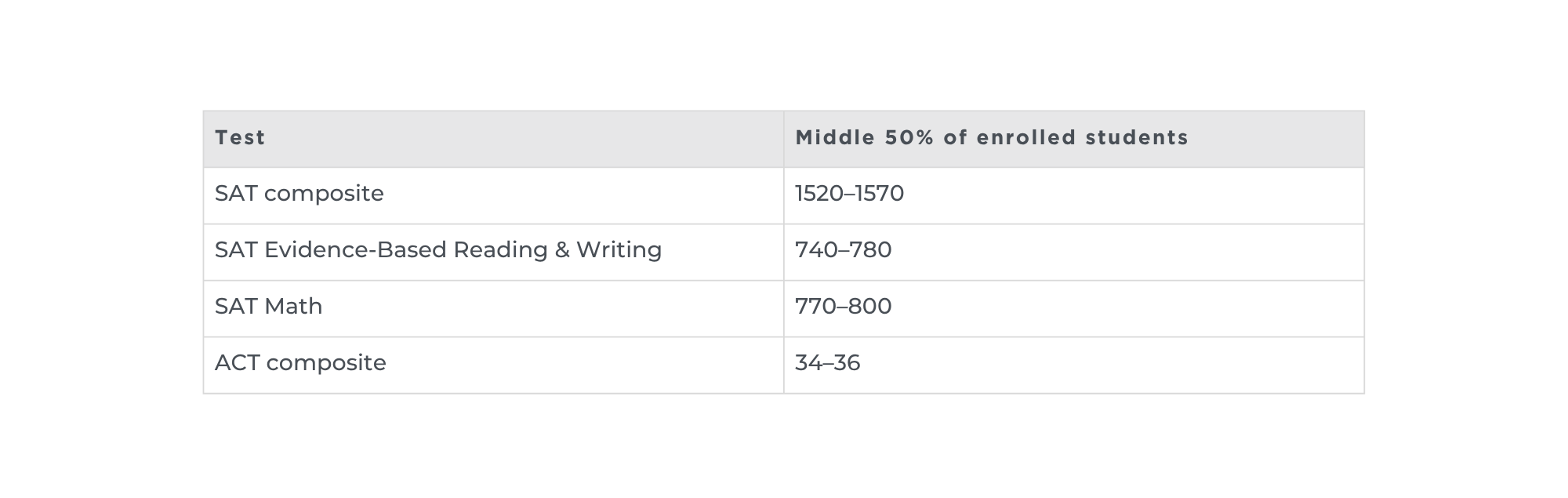
The middle 50 per cent range means half of enrolled submitters sat inside these bands. A quarter scored above the upper figure. A quarter scored below the lower figure. Aiming for the upper end of the range, or above, gives your file the clearest possible read. Our SAT tutoring is built around reaching Stanford’s middle-50% range. Below the lower figure, a strong context becomes essential: exceptional grades in a rigorous curriculum, standout work outside the classroom, or a background that adds meaningful diversity to the class.
SAT or ACT
Stanford treats both tests as equivalent and superscores both, meaning it considers your highest section scores across all sittings. The choice comes down to which suits you as a test-taker. The SAT is digital and adaptive, with two sections (Reading & Writing, and Math). The ACT covers four sections (English, Math, Reading, and Science), each with its own focus. A short diagnostic in each is the fastest way to see which plays to your strengths.
How many times can you sit the test?
Two or three sittings is the norm for competitive applicants. Stanford does not penalise multiple sittings, and superscoring removes the risk of one weaker performance dragging your record down. Plan your test dates around the application deadline rather than around the school calendar, and leave at least one sitting in reserve as a fallback.
Restrictive Early Action versus Regular Decision
Stanford offers two application routes: Restrictive Early Action (REA) and Regular Decision (RD). Picking between them well can measurably affect your chances.
What "restrictive" means at Stanford
Stanford's REA is non-binding, so an admitted REA applicant can wait until the standard 1 May reply date before committing. The "restrictive" part sits during the application phase. While your Stanford REA application is active, you may not apply early to any other private US university, and you may not apply to any other university's binding Early Decision programme. You can still apply early to public US universities and to universities outside the US, including Oxford and Cambridge.
One strict Stanford rule is worth flagging: an applicant denied in REA may not reapply in Regular Decision for the same cycle. This differs from how deferrals work and makes the REA submission a one-shot decision.
The acceptance rate gap
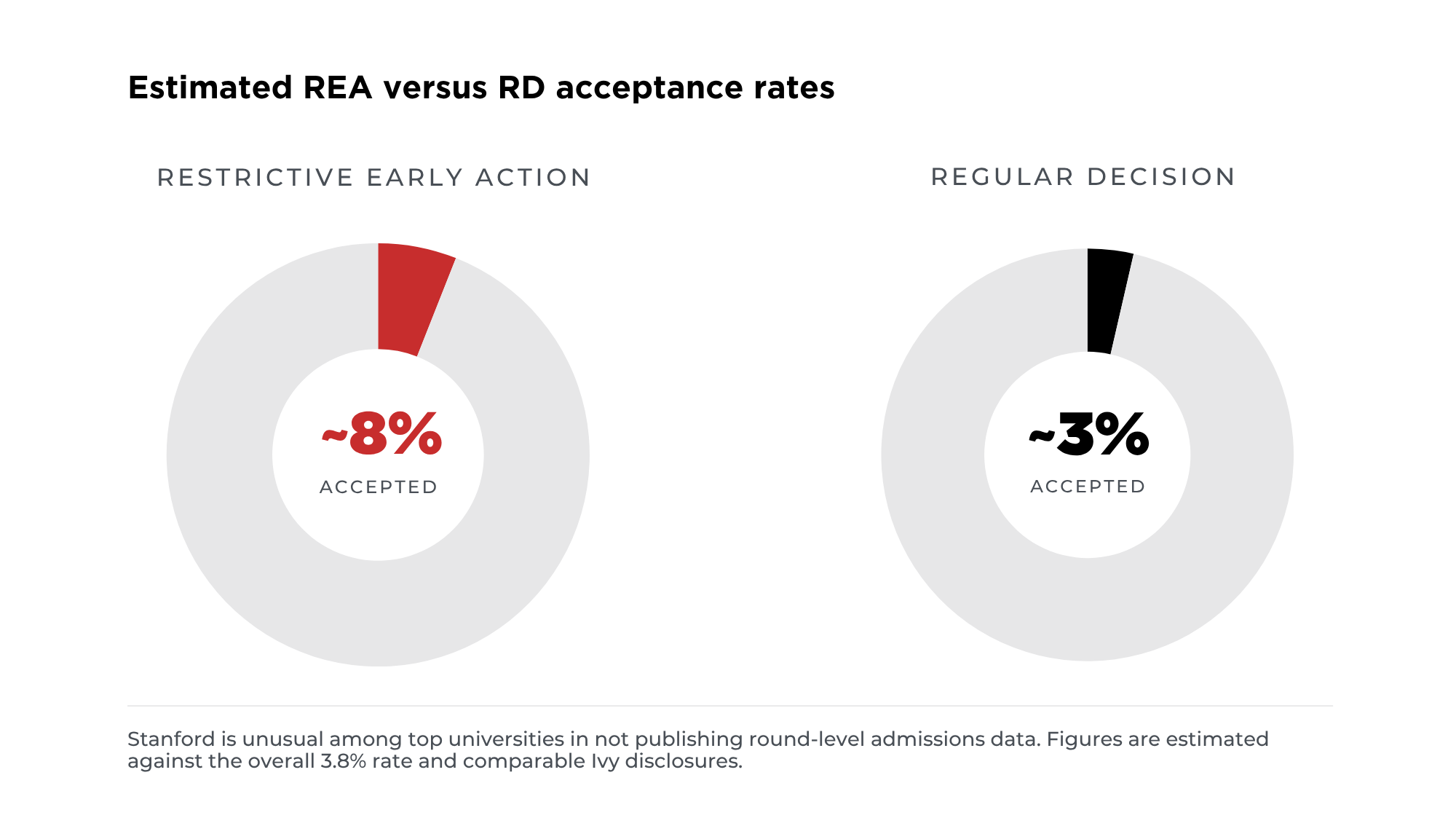
The REA round has historically been meaningfully more forgiving than the regular round. As with the Ivies, this is not a discount for applying early. The REA pool skews stronger: recruited athletes, legacy applicants and students whose files are polished by early November all cluster there. The visible advantage reflects pool composition as much as any admissions preference.
Should you apply REA?
Apply REA only if your file is at its strongest by 1 November. Stanford's rule that denied REA applicants cannot reapply in RD makes this a higher-stakes decision than at some universities. If your essays, tests and extracurricular narrative will be measurably stronger by January, waiting for RD is the safer call. A rushed REA application loses more than it gains.
Common App and Stanford distinctive essays
Stanford uses the Common Application, and its essays are among the most distinctive of any top US university. The Stanford supplement rewards voice, specificity and a particular quality that the admissions office calls "intellectual vitality." Every applicant writes three longer essays and five short answers. Nothing on the supplement is optional.
The Stanford supplement
Stanford's supplement is longer than most. The three main essays each ask for 100 to 250 words, and the five short answers are capped at 50 words each. The total writing load is comparable with Yale or Princeton, but the shape of what Stanford asks for is unique.
The roommate letter in particular
Stanford's "note to your future roommate" essay is one of the most famous prompts in US admissions. It is deceptively hard. The prompt rewards personality and specificity, and it punishes applicants who treat it as another opportunity to list achievements. The strongest responses sound genuinely like a letter to a stranger you want to live with. They are warm, specific about daily rituals or minor obsessions, and quietly funny. They give the admissions officer a sense of what you would actually be like to share a kitchen with.
Intellectual vitality
Stanford's own language around "intellectual vitality" shows up in the first essay prompt and in the admissions office's published guidance. What they mean by it is a visible excitement about ideas, discovered independently rather than performed for an application. The strongest responses are specific to one idea (not a field) and carry evidence that you have engaged with that idea beyond what the curriculum required.
The roommate letter in particular
Stanford's "note to your future roommate" essay is one of the most famous prompts in US admissions. It is deceptively hard. The prompt rewards personality and specificity, and it punishes applicants who treat it as another opportunity to list achievements. The strongest responses sound genuinely like a letter to a stranger you want to live with. They are warm, specific about daily rituals or minor obsessions, and quietly funny. They give the admissions officer a sense of what you would actually be like to share a kitchen with.
Common App essay versus UCAS personal statement
UK students sometimes hope to repurpose their UCAS personal statement for the Common App. It rarely works. The UCAS statement is a defence of your academic case for a single subject, aimed at the tutor who will teach you. The Common App essay is a piece of personal writing aimed at admissions officers who may know nothing about your intended subject. Write them separately, from scratch.
The Common App essay vs the UCAS personal statement
UK students often try to adapt their UCAS personal statement for the Common App. It rarely works. The UCAS statement is a defence of your academic case for a single subject, written to convince the tutor who will teach you. The Common App essay is a piece of personal writing, written to introduce you as a whole person to admissions officers who may know nothing about your intended subject. They serve different purposes and reward different styles. Write them separately, from scratch.
Extracurriculars and intellectual vitality
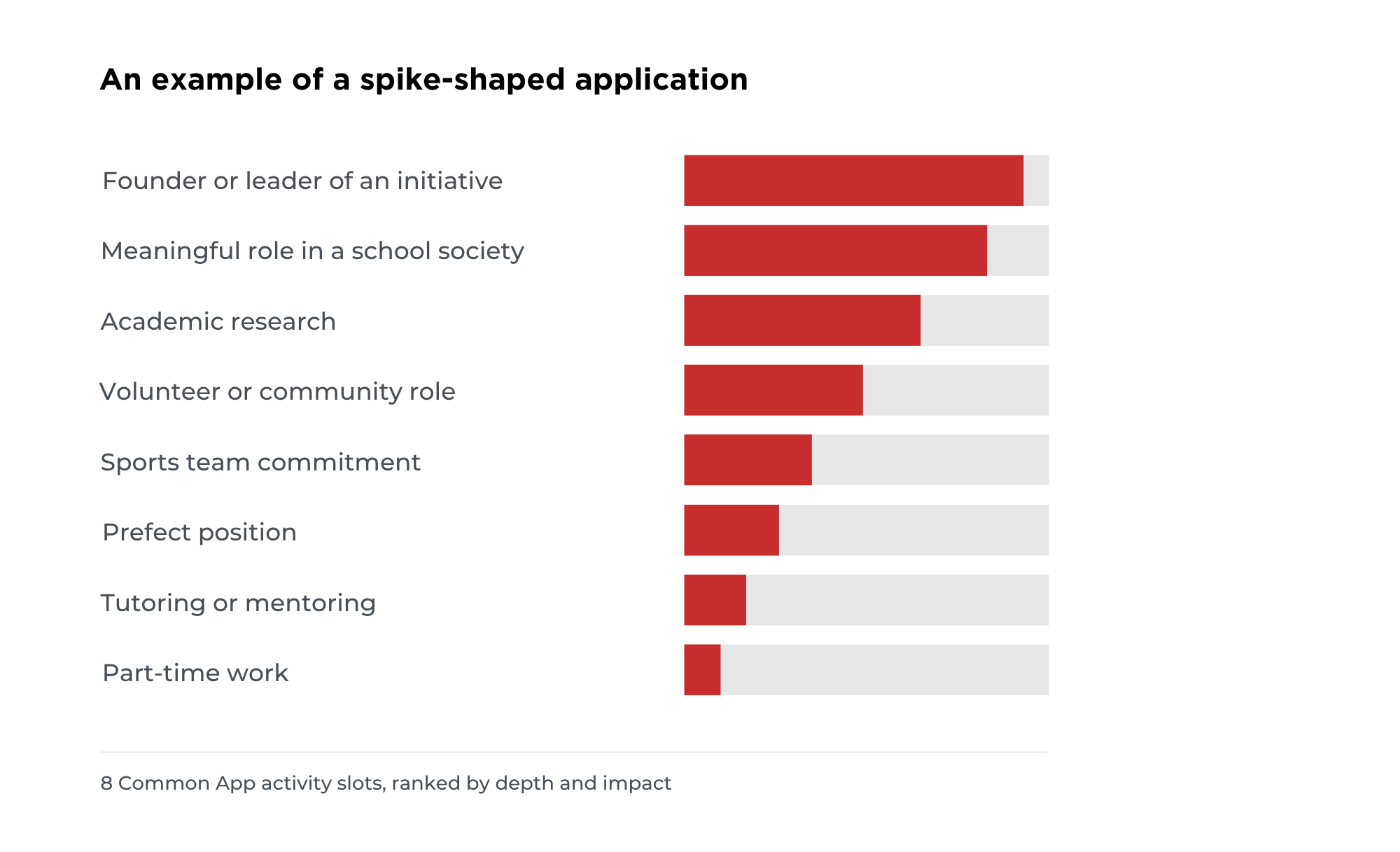
Stanford reads extracurriculars through the same lens as its essays. The question is not how many activities you did, but what they reveal about how you spend your discretionary time, what pulls your attention, and what you have made of the opportunities in front of you. The Common App activities list offers ten slots. Stanford reads them as evidence rather than as a resume.
The pattern Stanford rewards is depth and demonstrable output, not breadth. A student who has founded something that works, written something that was published, built something that functions, researched something that produced an answer, or competed at a genuine national level in one or two areas, is reading right into what Stanford's admissions office calls "self-initiated intellectual exploration."
The Silicon Valley adjacency
Stanford's physical proximity to the Bay Area tech ecosystem shapes who applies and who gets in. Students who have built working products, launched startups, written code that solves actual problems, or contributed to open-source projects have an advantage at Stanford that they would not have at a comparably selective East Coast university. This is not a formal preference. It is a cultural fit that comes through in how the admissions office responds to evidence of building.
For UK students specifically
British sixth forms produce students with generalist extracurricular profiles: house prefect, DofE, a couple of sports, maybe a society role. That profile reads as normal to Stanford rather than strong. The students we help place at Stanford almost always have one or two areas where their commitment goes well beyond the school menu, with tangible outputs that someone outside their family would recognise. Building that takes years, not months.
The activities list itself
The Common App limits each activity description to about 150 characters. Write for impact: what you did, what it produced, what it took. Titles matter less than what you actually did with them. The order of the ten activities is yours to set, and the top of the list carries the most weight. Lead with the pieces of the file you want the reader to remember.
When should you start preparing for Stanford?
Stanford rewards depth built over time. Every meaningful piece of a Stanford application, from the extracurricular depth to the essay voice to the testing confidence, improves when the planning starts earlier. Here is what strong applicants are doing at each stage.
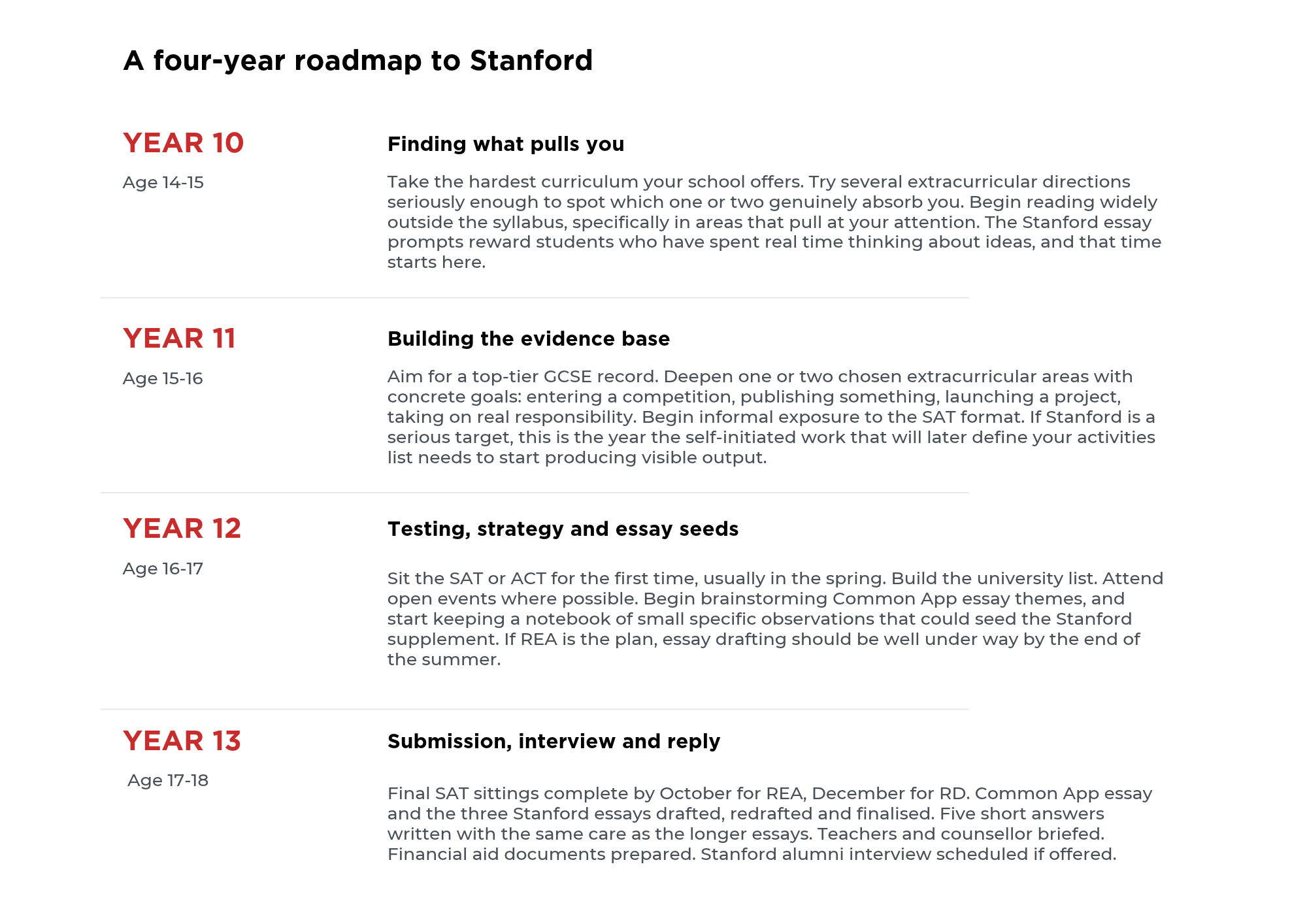
Arriving later in the timeline is manageable but harder. The intellectual vitality Stanford reads for is almost impossible to manufacture in six months. For late-starters, the focus becomes surfacing what is already there, telling it at its strongest, and building the one or two concrete outputs that can realistically be produced in the time remaining.
Why choose A-List?
Our private consultancy empowers students to strategically showcase their strengths, giving them a decisive edge in competitive admissions. See some of our exceptional results:
Getting into Stanford: FAQs
Extremely. Stanford admitted around 3.8 per cent of applicants to the Class of 2029, and international students make up roughly 12 per cent of the class. The academic bar for internationals is identical to the domestic bar, though Stanford is not need-blind for international applicants, which can affect decisions for families requesting substantial aid.
The Ivy League is a specific athletic conference of eight universities in the north-east of the United States. Stanford is in California and was founded in 1885, a generation after the Ivies. In academic prestige and selectivity, Stanford sits at or above every Ivy, but the Ivy label itself is a geographic and historical designation rather than a ranking. UK applicants should treat Stanford as the equivalent of Harvard or Yale in admissions difficulty.
If your file is genuinely strongest by 1 November, yes. The REA round historically admits at a meaningfully higher rate than Regular Decision. However, Stanford is unusual in that applicants denied in REA cannot reapply in RD for the same cycle. That makes REA a one-shot decision, and submitting a weaker application early can cost you an offer you might have won in January.