
How to get into Yale
How hard is it to get into Yale?
.png?width=324&height=360&name=A%20(6).png)
.png?width=324&height=360&name=A%20(7).png)
Yale is one of the most selective universities in the world, and the raw acceptance rate only tells part of the story. The pool it selects from is what makes the process so demanding.
Every year, roughly fifty thousand students apply to Yale for around 2,300 places. The vast majority are academically capable of doing the work. In practice, the great majority of applicants could handle Yale's coursework, and thousands could handle its most demanding courses without difficulty. Excellence, in other words, is the entry ticket. It gets your application read, but it doesn't get you an offer.
Even if you are the strongest student in your school, you are competing against thousands of students who fit the same description. Every one of Yale's admitted students had a compelling academic record. What separated them was everything else: the shape of their story, the depth of their commitment, the quality of their thinking, and the way they came across on the page.
Yale is unusually explicit about this. Its Common Data Set publicly rates the application essay, extracurricular activities, talent, and character as very important to admission decisions, alongside academics. In a pool where most applicants have excellent grades, this is how Yale chooses who gets an offer and who doesn't.
Yale's acceptance rates and recent trends
Yale's overall acceptance rate has hovered between 3.7 and 4.6 per cent for the last five cycles. It ticked up in 2025 as application volume fell following the reinstatement of standardised testing, then drifted back down as applications surged again for the Class of 2030.
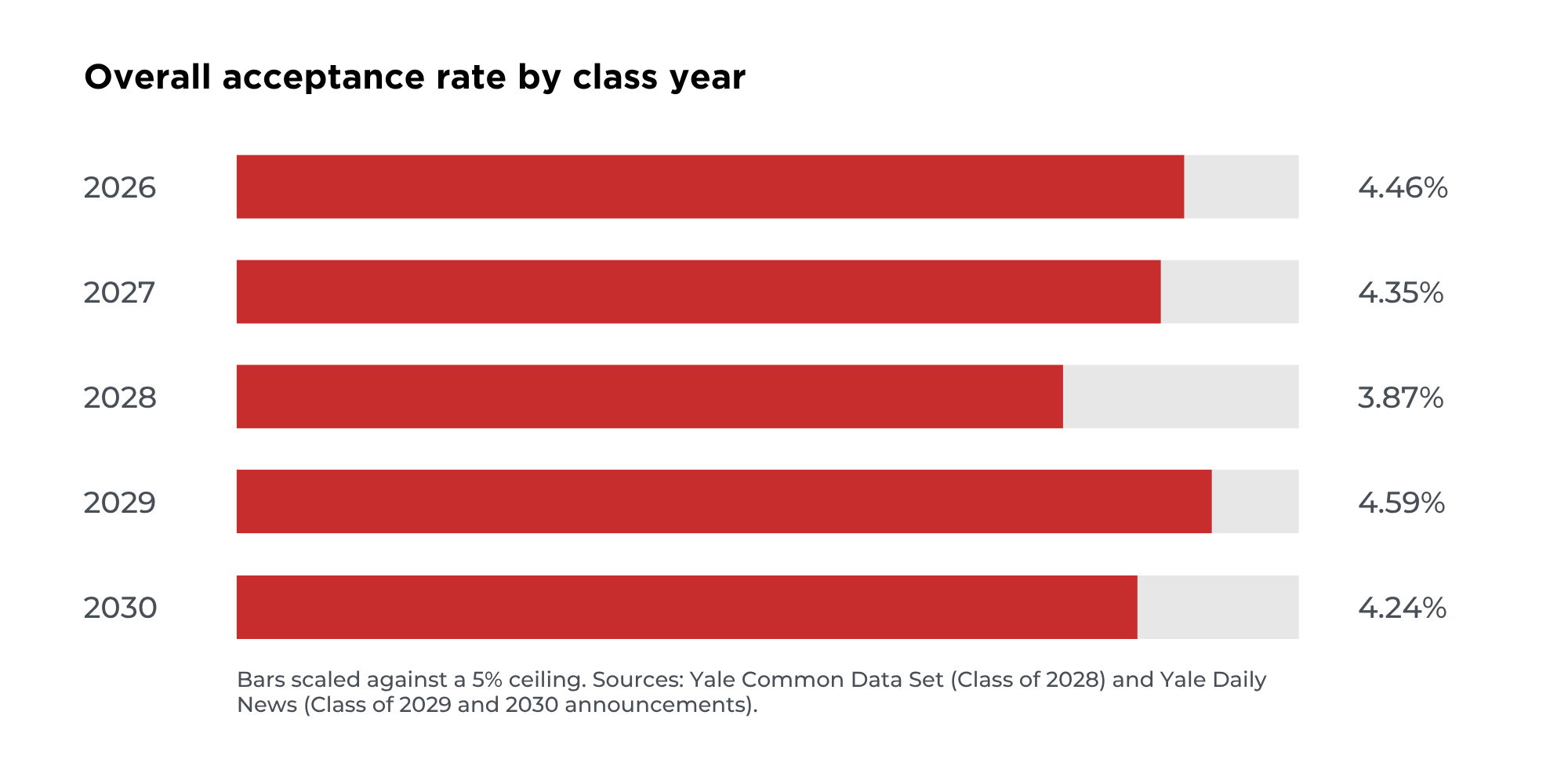
Two structural changes are worth paying attention to . First, from the Class of 2029 onwards, Yale reinstated its testing requirement after four cycles of test-optional admissions. Yale's version, called test-flexible, accepts SAT, ACT, AP or IB scores rather than requiring SAT or ACT specifically. Application volume dropped by around 13 per cent as a result. Second, Yale expanded its undergraduate class size by roughly 100 students starting with the Class of 2029, meaning admits rose modestly even as applications fell.
The yield rate is also worth looking at. Yale enrols roughly 70 per cent of its admitted students each year, one of the highest yield rates in global higher education though lower than some of its peers. In practical terms, more than two in three admitted students pick Yale over every other offer they hold. That means Yale fills most of its class from first-round admits, with limited movement from the waitlist.
What academic profile do Yale admissions teams look for?
Yale does not publish a minimum GPA, and there is no cutoff score. What the Common Data Set reveals is the range within which almost every admitted student sits.
.png?width=2000&height=833&name=A-list%20stats%20(29).png "A-list stats (29)")
UK equivalents
For UK A-Level students, Yale has no published grade requirement, but competitive applicants typically hold predicted grades of A*A*A* or stronger, in academic subjects that align with their intended direction of study. For IB students, competitive applicants typically hold predicted scores of 42 to 45 out of 45. GCSEs matter too. Yale reads the whole academic record, and a Year 11 with a full sweep of grade 9s carries genuine weight.
.png "A-list stats (30)")
Course rigour matters as much as grades
Yale explicitly rates the rigour of secondary school record as very important. What courses were available at your school? Did you take the most demanding options offered? A perfect record in an undemanding programme reads very differently from a slightly lower record earned across a school's hardest possible curriculum. Take the hard subjects, take the extra ones, and take them seriously.
What UK and international applicants need to know
International students make up roughly 11 per cent of the Yale undergraduate class, drawn from more than 65 countries. The bar is high, and it is essentially the same bar as for domestic applicants. What differs is context, and a few practical points that catch UK students out.
.png?width=2000&height=866&name=A-list%20stats%20(31).png "A-list stats (31)")
Predicted grades are crucial
You will apply during Year 13, before your A-Level or IB results are final. Yale reads predicted grades in the context of your school and, critically, your GCSEs. Strong predicted grades in a demanding curriculum, on top of an excellent GCSE record, is the picture the admissions committee is looking for.
Contextual references
Your teachers and counsellor should briefly explain the UK system. Grading scales, curriculum choices and school context are unfamiliar to some readers. A one-paragraph note in your counsellor's letter explaining what A*A*A* means at your school, or what "top set" implies, gives your file the frame it needs.
The Oxbridge overlap
Many of our students apply to Yale alongside Oxford or Cambridge. The two systems reward genuinely different things. Oxbridge wants a highly focused academic case for a single subject. Yale wants a rounded person with a distinctive intellectual direction. You cannot write one personal statement for both systems, and the students who try tend to hurt themselves in both applications. Plan for two parallel workflows.
Testing access from the UK
SAT sittings run several times a year at UK test centres, mostly in London and larger cities. Places fill up months in advance. Register early, and build in enough capacity to sit twice or three times if needed. Yale's test-flexible policy means UK students who are taking IB Higher Level or AP exams have a genuine alternative if SAT access is difficult.
Application deadlines and key dates for Yale
These are the standard dates for the 2026–27 application cycle, for 2027 US university entry. Always confirm on Yale's official admissions website before submitting.
.png?width=2000&height=568&name=A-list%20stats%20(26).png "A-list stats (26)")
For UK students, the January regular deadline sits alongside the 15 January UCAS equal consideration deadline. Building the two applications side by side is possible, and many of our students do exactly that, though the Common App essay and the UCAS personal statement demand very different approaches. We cover the differences in detail later in the guide.
SAT & ACT and Yale's test-flexible policy
Yale requires a standardised test score for all first-year applicants from the Class of 2029 onwards. The university ended its test-optional policy in February 2024. Uniquely among the Ivies, Yale's policy is test-flexible: you can meet the requirement with an SAT, ACT, Advanced Placement (AP), or International Baccalaureate (IB) score.
The scores of admitted students show what competitive looks like in practice.
.png?width=2000&height=767&name=A-list%20stats%20(27).png "A-list stats (27)")
.png?width=2000&height=745&name=A-list%20stats%20(30).png "A-list stats (30)")
The middle 50 per cent range means that half of enrolled students scored inside these bands. A quarter scored below the lower figure. A quarter scored above the upper figure. Aiming for the upper end of the range, or above, gives you the clearest read on your file. Below the lower figure, a strong context becomes essential: exceptional grades in a rigorous curriculum, standout extracurriculars, or a background that adds meaningful diversity to the class.
SAT or ACT: which one?
Yale treats the SAT and ACT as equivalent, so the choice comes down to which suits you as a test-taker. The SAT is digital and adaptive, with two sections (Reading & Writing, and Math). The ACT covers four sections (English, Math, Reading, and Science), each with its own focus. Neither is easier to prepare for, and neither is more highly regarded by Yale. UK students can sit both at test centres in London and other major cities.
A short diagnostic in each is the fastest way to see which plays to your strengths. We prepare students for both, and use the diagnostic to guide the right preparation track.
What about AP and IB?
Yale's test-flexible policy is a genuine option for UK students. If you are taking IB Higher Level exams or preparing to sit AP tests, these can meet the testing requirement. In practice, most of our UK students still choose to sit the SAT or ACT because the results arrive earlier and give the admissions office a comparable score across the applicant pool. IB and AP are strongest as a supplement to, or a backstop for, an SAT or ACT score.
How many times to sit
Two or three sittings is the norm for competitive applicants. Yale superscores both the SAT and ACT, meaning it considers your highest section scores across all sittings. That reduces the risk of one weaker day, and it means preparation time and test dates should be planned in advance rather than left to the autumn of your final year.
Single-Choice Early Action versus Regular Decision
Yale offers two application routes: Single-Choice Early Action (SCEA) and Regular Decision (RD). Choosing between them well can materially affect your chances.
What "single-choice" means
SCEA is non-binding. If admitted, you are not obliged to attend, and you have until the standard May reply date to decide. The restriction applies during the application phase: while you have an active SCEA application at Yale, you may not apply early to any other private US university. You can still apply early to public US universities and to universities outside the US, including Oxford and Cambridge.
.png?width=2000&height=1140&name=A-list%20stats%20(25).png "A-list stats (25)")
The acceptance rate gap
The early round has consistently been significantly more forgiving than the regular round. That is not a discount for applying early. It reflects the strength of the SCEA pool: recruited athletes, legacy applicants and students whose files are polished enough to submit by the November deadline all cluster in the early round.
Should you apply SCEA?
The honest answer is that SCEA rewards applicants who are already strong on 1 November, and offers little to those who need the extra two months. If your testing, grades, essays and extracurriculars are ready to be seen at their best in early autumn, apply SCEA. If any part of your file will be materially stronger by January, hold for Regular Decision. A rushed SCEA application does not gain the statistical advantage the raw acceptance rate suggests.
Common App and Yale essays
The essays are where competitive applications are made or lost. Yale rates the application essay as very important, and it shows in the supplement: Yale's is the most extensive essay package in the Ivy League, and the one that rewards planning the most.
The Common App essay
You will write one Common App personal statement, up to 650 words, that goes to every US university you apply to. It is not a CV in prose form. It is a chance to show admissions officers who you are as a person, in your own voice, at genuine emotional depth. The strongest essays we see are specific, unusual, honest and quietly confident. They reveal character through a moment or an idea, rather than reciting achievements the reader can see elsewhere in the file.
The Yale supplemental essays
Yale asks for seven written components in total, alongside your choice of up to three intended academic areas. The word limits are ruthless, and each essay needs to be one specific idea, told concretely, with a light touch.
The Common App essay versus the UCAS personal statement
UK students often try to adapt their UCAS personal statement for the Common App. It rarely works. The UCAS statement is a defence of your academic case for a single subject, written to convince the tutor who will teach you. The Common App essay is a piece of personal writing, written to introduce you as a whole person to admissions officers who may know nothing about your intended subject. They serve different purposes and reward different styles. Write them separately, from scratch.
Extracurriculars and the "spike"
The single biggest misconception about US admissions is that a long list of activities signals strength. The opposite is closer to the truth. Yale reads thousands of applications from students who have joined every club, played two sports, held prefect positions, done a bit of volunteering, and mentored younger students. That profile is common, so it rarely wins offers.
Yale is one of the few Ivies that publishes exactly how much weight it gives to extracurriculars. In the Common Data Set, it rates extracurricular activities, talent, and character as very important, alongside academics. That is unusually direct, and it tells you where applications are actually decided.
What wins offers is depth. A meaningful commitment to one or two areas, sustained over years, that has produced real achievement, or made a genuine contribution, or created something that would not exist otherwise. Admissions officers call this a "spike": the thing that makes an applicant memorable in a room full of strong ones.
.png?width=2000&height=1217&name=A-list%20stats%20(22).png "A-list stats (22)")
What a spike looks like
A spike can be almost anything. For example, a student who has founded a working charity, a national-level fencer, a researcher who has co-authored a paper with a university lab. What the examples share is not the field, but the depth and the demonstrable output.
The activities list
The Common App allows ten activities, listed in order of importance. Prioritise the ones where you have the strongest evidence of depth and outcome. Descriptions are tightly character-limited, so write for impact: what you did, what it produced, what it took. Leadership titles matter less than what you actually did with them.
For UK students
UK schools tend to lean on generalist extracurricular participation: DofE, house sports, a couple of societies. That reads as normal to a US admissions officer, not as strong. The students who convert Yale interviews into offers usually have one or two areas that go well beyond the school menu. Building that should start early in Year 10 or 11.
When should you start preparing for Yale?
Yale rewards depth built over time. The single most useful thing you can do to strengthen a Yale application is to start early. Here is what the strongest applications typically look like at each stage.
.png?width=2000&height=1414&name=A-list%20stats%20(32).png "A-list stats (32)")
While starting early is ideal, starting later is possible, and we successfully work with students who come to us later in their application journey. The plan simply becomes more focused, and the level of strategic clarity has to be higher. There is less room to build depth, so the depth you already have needs to be told at its strongest.
Why choose A-List?
Our private consultancy empowers students to strategically showcase their strengths, giving them a decisive edge in competitive admissions. See some of our exceptional results:
Getting into Yale: FAQs
Very. Yale admitted around 4.6 per cent of applicants to the Class of 2029, and international students make up roughly 11 per cent of the class. A UK applicant is entirely competitive, though the bar is high and the process is unfamiliar to most British students. Early, expert strategy is the single biggest lever you have.
Yale requires a standardised test score, but uniquely among the Ivies it accepts SAT, ACT, AP or IB scores. This "test-flexible" policy took effect for the Class of 2029. Most competitive applicants still submit an SAT or ACT because it gives the admissions office a comparable score across the pool. Admitted students sit in roughly the 1480 to 1560 SAT range.
Yes, and many of our students do. Single-Choice Early Action limits early applications to other private US universities, and does not restrict Oxbridge. The written work required by each system is quite different, so you should treat them as two parallel workflows rather than one shared personal statement.